


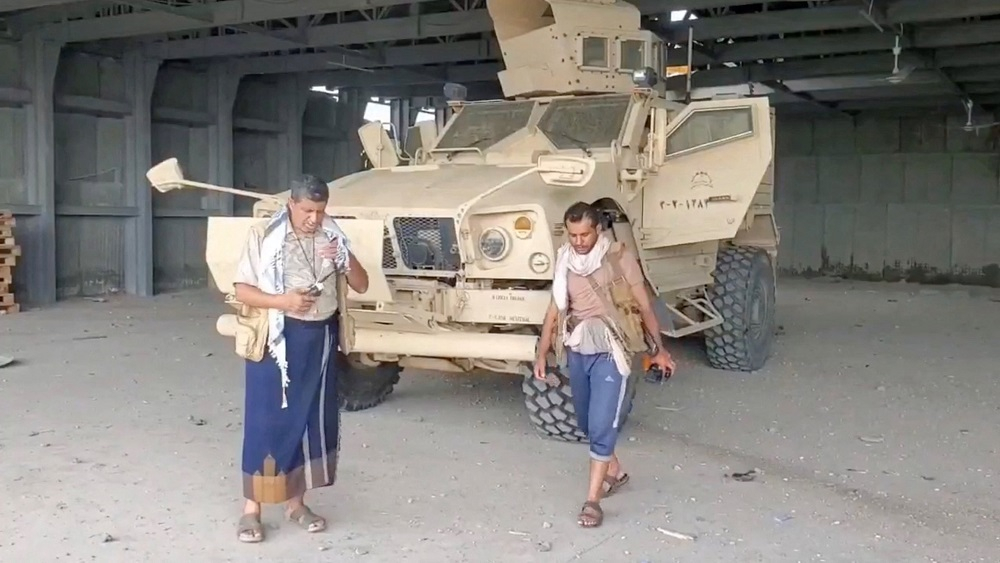
Yemen's Houthis seized control of the strategic Red Sea port city of Mocha on Thursday, with witnesses telling of fighters marching on the area chanting "death to America, death to Israel."
The Houthis, who control large parts of northwest Yemen, launched a large-scale offensive last week against Yemeni government forces, who are backed by Saudi Arabia.
They also launched attacks on Saudi territory that left dozens of people wounded, in a conflict that has reignited during the Middle East war that began with US-Israeli strikes on Iran in late February.
A Yemeni military source said on Thursday that the Iran-backed Houthis were advancing towards the strategic Bab al-Mandeb strait "after having taken control of Mocha."
The waterway, which links Asia to Europe via the Red Sea and Suez Canal, has gained importance as a transit route since the start of the wider Middle East war, which saw Iran blockade the Strait of Hormuz.
The regional war has disrupted maritime traffic in the Gulf, causing oil prices to soar.
On Thursday, the US oil contract WTI surpassed US$100, after Brent North Sea crude – the main international benchmark – already did so on Wednesday.
The military source said the Houthis also seized Zuqar Island in the southern Red Sea, "after rocket attacks and a ground assault carried out using boats transporting fighters."
In a statement, Tarek Saleh, who heads the Yemeni National Resistance Forces that controlled Mocha, said he moved his command centre "to a safe location" to regroup.
Government forces have paid "a heavy price in recent days in the face of a Houthi offensive that was planned and supported by Iran," he added.
Before the offensive, the Houthis already controlled a large part of Yemen's north, including the capital Sanaa, as well as the major port city of Hodeidah on the Red Sea.
But they did not yet hold any areas directly overlooking Bab al-Mandeb.
With their drones and missiles, the Houthis have been able to disrupt traffic in the Red Sea.
But "controlling the coast would strengthen Houthi maritime coercion," said Andreas Krieg, a security expert at King's College London.
The ongoing hostilities risk returning Yemen to a conflict that left hundreds of thousands of people dead and sparked one of the world's worst humanitarian crises.
The Houthis, after seizing Yemen's capital and forcing out the government, fought the Saudi-led coalition from 2015 until a United Nations-brokered ceasefire in 2022. (AFP)
Edited by Robert Kemp
Yemen's Houthis seize key city of Mocha on Red Sea
2026-09-11 HKT 05:11
Share this story


Jamie Clarke reports

