


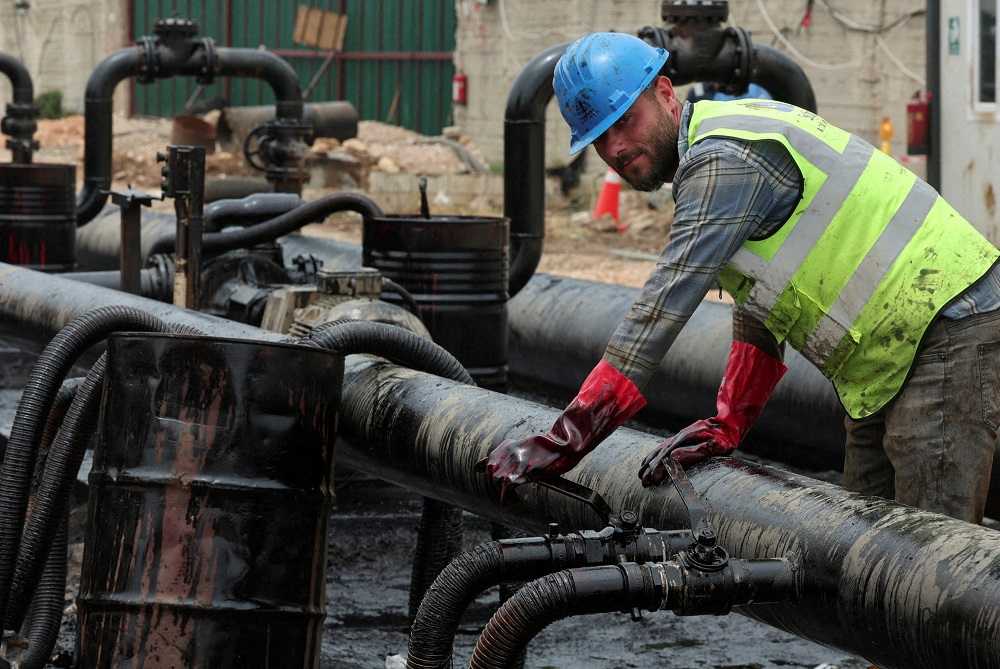
Oil prices surged on Thursday as advances by Yemeni rebels threatened the flow of crude supplies while yields on long-term US Treasury bonds reached new multi-year highs following data showing an uptick in US wholesale inflation.
The benchmark US oil contract, West Texas Intermediate, jumped above US$100 a barrel on Thursday after Yemen's Houthis seized control of the strategic Red Sea port city of Mocha on Thursday.
The international benchmark Brent crude soared more than six percent past US$107 a barrel, hitting its highest level since May.
Major Wall Street indices spent the entire session in the red, with the S&P 500 falling 0.6 percent, dropping for a fourth straight day.
"For markets it's getting harder and harder to ignore the combination of rising oil prices and higher bond yields, which are starting to weigh on investor sentiment during what historically has been a seasonally challenging period for stocks," said Angelo Kourkafas of Edward Jones.
Long-term US Treasury bond yields continued to climb, with the 30-year bond reaching 5.36 percent, a new peak since 2007.
The jump came after the US government released producer price inflation numbers showing an acceleration in August driven by energy prices. The index climbed 5.4 percent in August, up from 4.8 percent in July.
"It's not necessarily the level, but the speed with which rates are increasing" that is concerning, Kourkafas said of bond yields.
Markets will get additional US inflation data with Friday's release of the August consumer price index.
A Yemeni military source said the Iran-backed Houthis were advancing towards the strategic Bab el-Mandeb strait, the waterway which links Asia to Europe via the Red Sea and Suez Canal, which would make it easier for them to disrupt Saudi shipping.
"This poses a further threat to global energy supplies," said Kathleen Brooks, research director at XTB.
The waterway has gained importance as a transit route since the start of the wider Middle East war, which saw Iran blockade the Strait of Hormuz and Saudi Arabia shift to exporting a portion of its production via the Red Sea.
Iran has recently stepped up attacks on ships trying to pass the Strait of Hormuz chokepoint, reducing flows that had picked up during the summer, and raising the prospect of supply disruptions well into the Northern Hemisphere winter.
The European Central Bank raised its benchmark rate to 2.5 percent on Thursday while warning that inflation "is set to remain well above target for an extended period."
While many investors took the comments as a sign of further tightening to come, the euro retreated against the US dollar, reflecting caution ahead of Friday's US inflation and uncertainty on how the Fed will react at next week's monetary policy decision.
The ECB rate hike "was already widely expected by markets," said Julian Pineda, market analyst at Forex.com, who said Friday's CPI report "could alter expectations regarding the Federal Reserve."
The S&P 500 fell 0.6 percent, to 7,592, the Dow also fell 0.6 percent, to 52,064, while the Nasdaq fell 0.7 percent, to 26,082. (AFP)
Edited by Robert Kemp
Surging oil prices, higher bond yields weigh on stocks
2026-09-11 HKT 07:44
Share this story


