


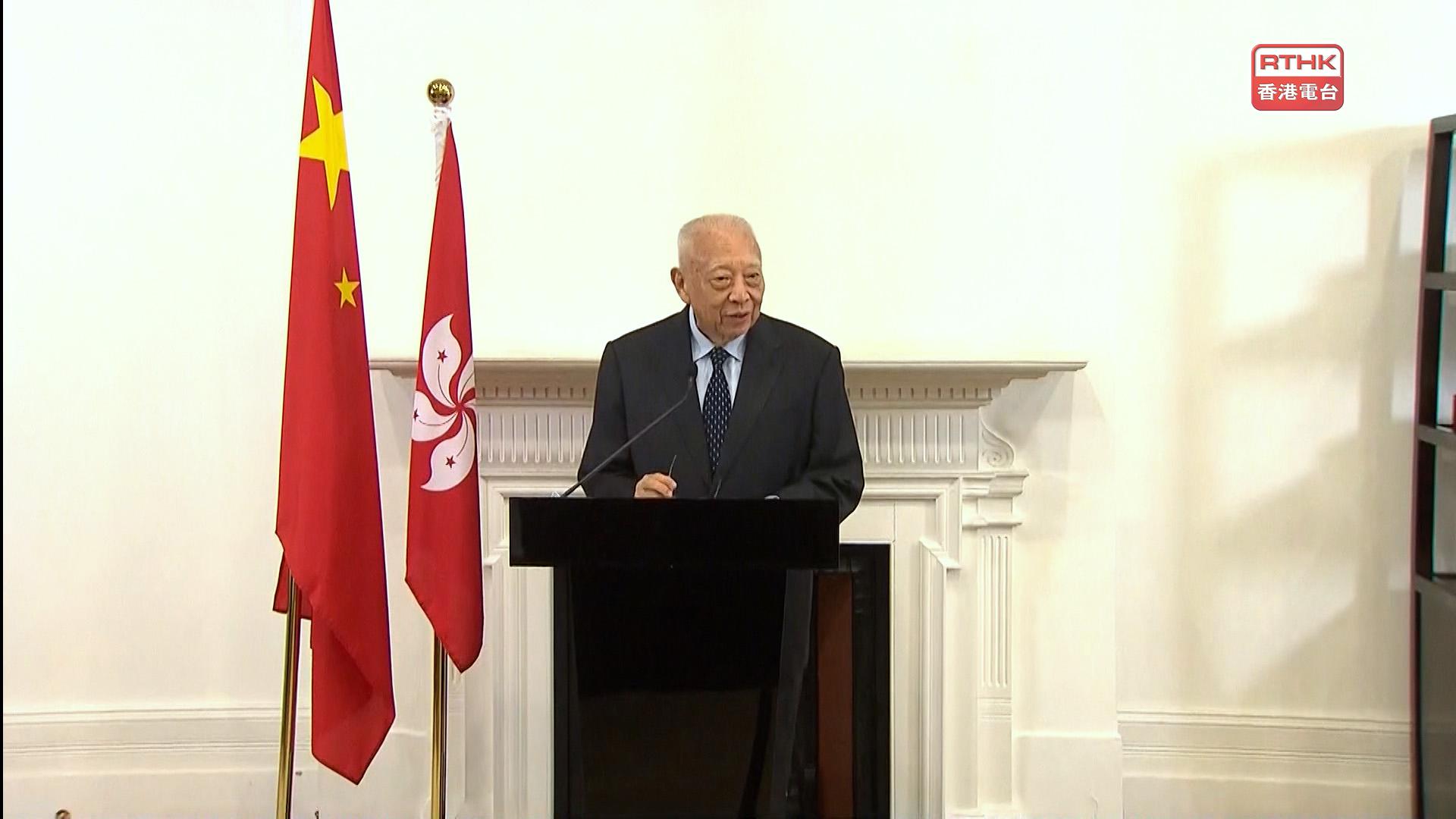
Several political heavyweights who worked with Hong Kong's first chief executive, Tung Chee-hwa, paid tribute to the late leader on Sunday, praising his foresight and major contributions to the city's development.
Tung passed away on Tuesday at the age of 89.
Speaking on a Commercial Radio programme, Elsie Leung, who served as Secretary for Justice during Tung’s administration, remembered him as a far-sighted leader.
She noted that Tung was always willing to listen to opposing views when handling major crises, such as the right of abode and illegal immigration disputes, as well as the reform of the rural representative election system.
“First of all, he was always patient enough to hear people out. Whether he agreed or not, he would listen until you had finished, and we had to explain our positions clearly to him,” Leung said.
“He also enjoyed immense trust from the central government. On many issues, he clearly conveyed Hong Kong's actual situation to the central government. With that strong backing behind us, we had the confidence to take bold steps when needed, such as requesting an interpretation of the Basic Law from the Standing Committee of the National People's Congress (NPCSC).”
Looking back at the steep challenges of the early post-1997 years, Leung recalled Tung’s belief that true leadership demands selflessness, free from deceit, resentment, and regret.
She added that the government at the time was highly transparent, maintaining open dialogue with the opposition and even sharing sensitive information, such as plans to seek an interpretation of the Basic Law from the NPCSC.
On the same programme, Tam Yiu-chung, who served on the Executive Council under Tung, praised Tung as a major contributor to the city's stability and development.
Tam, now a consultant for the Chinese Association of Hong Kong and Macao Studies, also lauded the late leader for his profound understanding of the "One Country, Two Systems" principle and his early push for Hong Kong to integrate into the country’s broader development.
“He saw the close ties between the country and Hong Kong. Today, we say we must integrate into the broader national development as the best path forward for our city. But he recognised that connection long ago, constantly reminding us that when the country prospers, Hong Kong prospers too,” he said.
Tam added that Tung consistently stepped up for Hong Kong during pivotal moments.
As an example, he pointed to Tung establishing the Our Hong Kong Foundation following the 2014 Occupy Central movement to unite different sectors and pool wisdom to solve deep-seated social issues.
Fanny Law, who served as Director of the first HKSAR Chief Executive Elect’s Office in 1997, described Tung as both demanding and approachable, treating everyone with equal respect regardless of hierarchy.
Law, who later served as the Secretary for Education and Manpower, said Tung attached great importance to education and youth development.
Even when government departments were forced to cut spending during the economic downturn following the 1997 Asian financial crisis, Tung made it clear that resources for education could not be reduced, she said.
Edited by Tony Sabine
Tung Chee-hwa lauded for contributions to HK
2026-09-13 HKT 12:16
Share this story


