


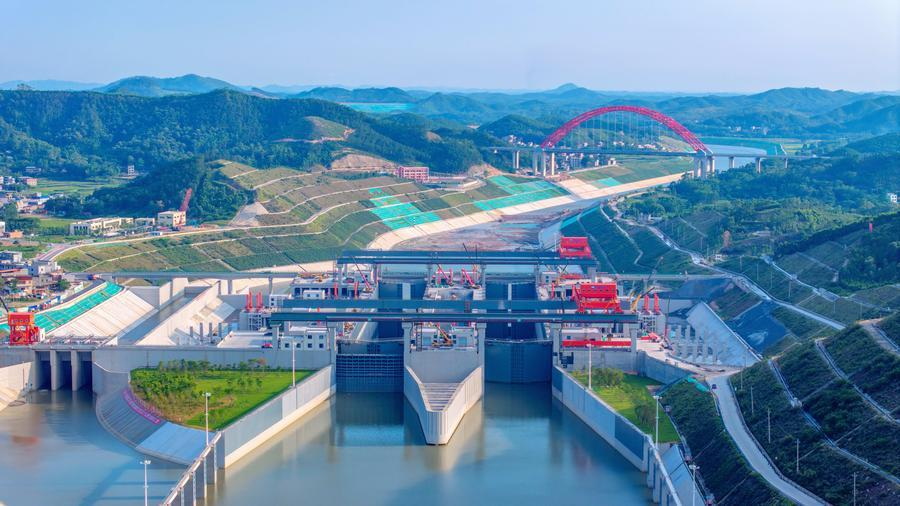
China opened the Pinglu Canal on Wednesday, giving its landlocked southwest a shortcut to the coast and overseas markets, particularly those in Asean, the country's largest trading partner.
Built at a cost of 72.7 billion yuan, the 134.2-kilometre canal runs from Nanning, capital of south Guangxi Zhuang Autonomous Region, to the Beibu Gulf, the closest maritime outlet for much of southwest China.
The canal stretches along the New International Land-Sea Trade Corridor, a strategic trade route connecting China's inland regions with Asean and other global markets.
It is the first river-to-sea canal project planned and coordinated at the national level since the founding of the People's Republic of China in 1949.
Designed for vessels of up to 5,000 tonnes, the canal shortens the inland waterway journey for goods from southwest China to the sea by more than 560 kilometres compared with traditional routes through ports in Guangdong.
It is expected to reduce overall logistics costs by 18 to 30 percent and save more than five billion yuan in transportation costs each year.
Lu Xinning, vice chairwoman of the regional government of Guangxi, said the canal creates a new link between China's market of 1.4 billion people and Asean's nearly 700 million consumers.
Its impact, she said, could extend beyond the movement of goods, spurring new cross-border investment and deepening regional supply-chain integration.
The canal took over four years to build.
Most of it was created by widening, deepening and straightening existing waterways, while a small section had to be excavated through dry land and mountainous terrain.
One of the biggest engineering challenges was a 65-metre difference in water level, roughly the height of a 20-plus-storey building.
Three navigation hubs, all featuring twin-line ship locks, were built to raise and lower vessels along the canal.
Environmental protection was another priority during construction.
More than 98 percent of the roughly 315 million cubic metres of earth and rock excavated during construction was reused.
The canal also includes a fish passage more than 480 metres long and a dedicated wildlife crossing for land animals including leopard cats and squirrels.
The canal opens in the first year of the country's 15th Five-Year Plan period (2026-2030), as the world's second-largest economy seeks to promote more coordinated regional development and further expand high-standard opening up – priorities outlined in the plan.
The new artery carries particular significance for China's southwest, which has long lagged behind the more prosperous eastern coast and faced higher costs getting goods to seaports.
Coal, ore, grain, new-energy materials and auto parts from the region can now take a more direct route to overseas markets.
China's trade with Asean exceeded US$1 trillion for the first time last year.
In the first seven months of 2026, total trade between the two sides reached US$744.41 billion, an increase of 24.7 percent year on year, accounting for 21.8 percent of China's total foreign trade during this period. (Xinhua)
Edited by Tony Sabine
China opens Pinglu Canal for trade shortcut to Asean
2026-09-16 HKT 13:46
Share this story


