


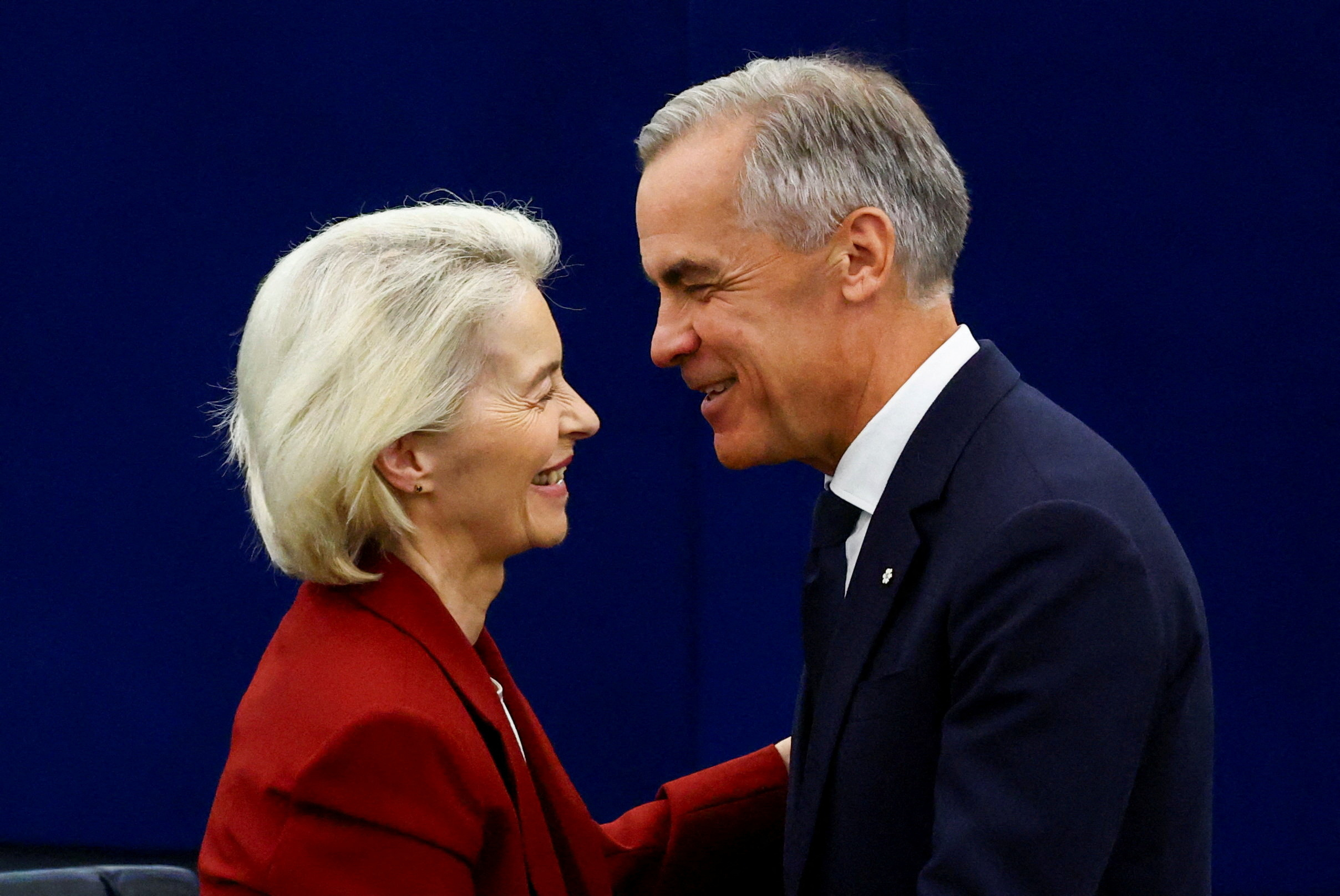
Canadian Prime Minister Mark Carney embraced the prospect of his country becoming the European Union’s first associate member, saying closer ties with the continent would ensure no country could control Canada’s markets or undermine its sovereignty.
Carney’s speech to the European Parliament in Strasbourg on Thursday repeatedly extolled cooperation between Europe and Canada — but the relationship with the US, which has defined Canada’s economy for decades and has increasingly soured, hung over the address.
Trump’s tariffs, demands for economic concessions, and repeated talk of making Canada the 51st state have pushed Ottawa to reduce its dependence on its neighbour and seek a far deeper economic, security and political relationship with Europe.
Carney told the parliament that he welcomed European Commission President Ursula von der Leyen’s proposal, though he acknowledged that “associate membership” remains to be defined.
He told reporters he was not pursuing full membership of the EU.
“We do not seek power to dominate others," he said.
“On the contrary, we are pursuing resilience so that no one can control our open markets, impair our sovereignty, threaten our territorial integrity, or undermine our freedoms, our democracies, our rule of law.”
The prime minister received a rousing welcome when he walked into the chamber in Strasbourg, France — with many lawmakers approaching him to shake his hand and ask for selfies — and a standing ovation after he spoke.
One parliamentarian had donned a Canadian hockey jersey.
On Wednesday, von der Leyen proposed making Canada the EU’s first associate member — a status that does not currently exist in the bloc’s treaties and would have to be created.
Carney, sitting in the front row of the chamber, nodded and rose to embrace von der Leyen as lawmakers gave the proposal a standing ovation.
Carney will host EU leaders for a summit in Montreal on October 29-30.
Canada sends roughly 70 percent of its exports to the United States, making it highly exposed to Trump’s tariffs.
Ottawa has retaliated and rejected demands that Carney says threaten Canadian sovereignty.
Europe took a different path, shelving retaliation and accepting tariffs of up to 15 percent on most EU exports to the US. (AP)
Edited by Tony Sabine
Carney says EU link can fortify Canada's sovereignty
2026-09-18 HKT 11:33
Share this story


