


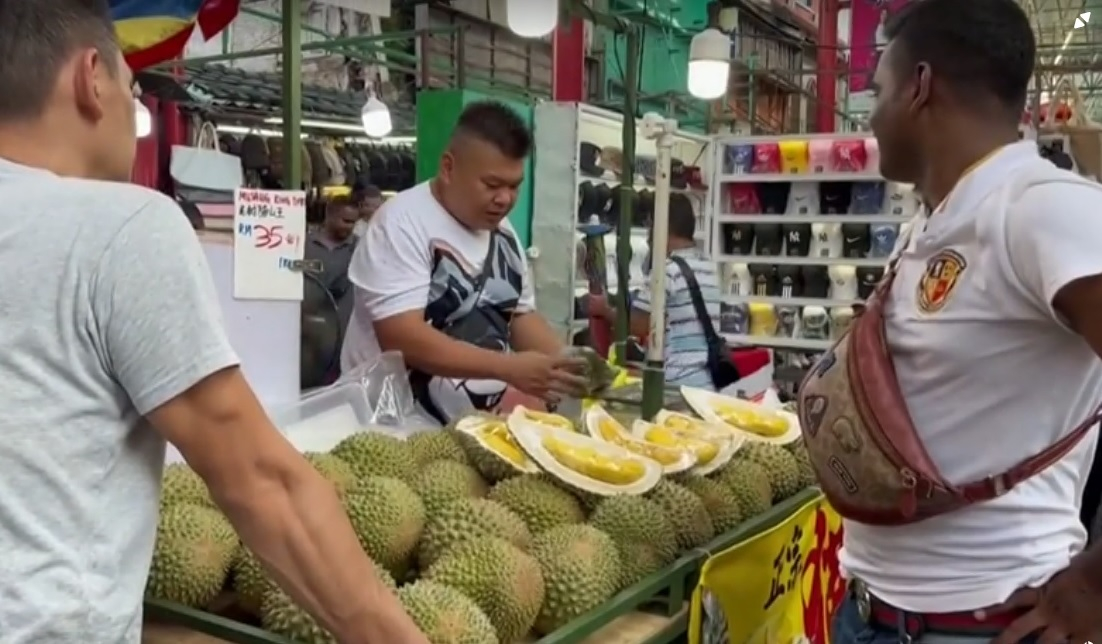



Malaysia is pushing to take durian, whose powerful smell delights its lovers and repels its haters, beyond its roadside stalls and family orchards, particularly targeting the Chinese market.
Devotees savour durian like wine.
For the Malaysian ones, the taste of their rich and creamy flesh varies widely across types.
Some are prized for their sweet custard and fruity notes, others for a hint of bitterness, an alcohol tinge or even a peanut butter flavour.
Malaysians' efforts to elevate the industry can be found in the capital, Kuala Lumpur, at a centre devoted exclusively to the fruit and the growing variety of products made from it.
At the Kuala Lumpur Durian Experience Centre, near the landmark Petronas Twin Towers, visitors venture into a replica durian orchard to discover the fruit’s culture and history.
In another room, a theatre show draws laughter.
Downstairs, visitors enjoy platters and egg tarts crafted from it.
Launched this summer after an investment of nearly US$2 million, the two-story centre spans about 1,900 square metres and is open daily.
Its durian shop welcomes guests from morning to midnight.
Its founder, Edison Ang, said the centre targets both local customers and tourists, especially those from China, the world's biggest durian importer.
He said Chinese palates have long been influenced by Thai durian culture.
“What we actually hope for now is not to get people who don’t eat durian to start eating durian," he said.
“Instead, we hope consumers who are already eating durian from other countries will switch to Malaysian durian.”
In 2025, China imported 1.87 million tonnes of fresh durian worth US$7.5 billion, with volume jumping over six times in the past decade.
Thailand’s earlier entry helped it secure over half that market by value in 2025.
Malaysia, which began exporting fresh durian to China in 2024, was dwarfed.
But for the first half of 2026, the value of China's fresh durian imports from Malaysia quadrupled compared with the same period last year, pointing to rapid growth.
Unlike their rivals, Malaysian growers typically do not harvest early, instead collecting only naturally ripened fruit caught in nets or ropes as they fall.
That’s the industry’s biggest advantage and also its biggest weakness, Ang said, as sellers have to race against time because the fruit’s shelf life is at most two to three days. (AP)
Edited by Tony Sabine
Malaysian durian industry eyes China market
2026-09-28 HKT 11:33
Share this story


