


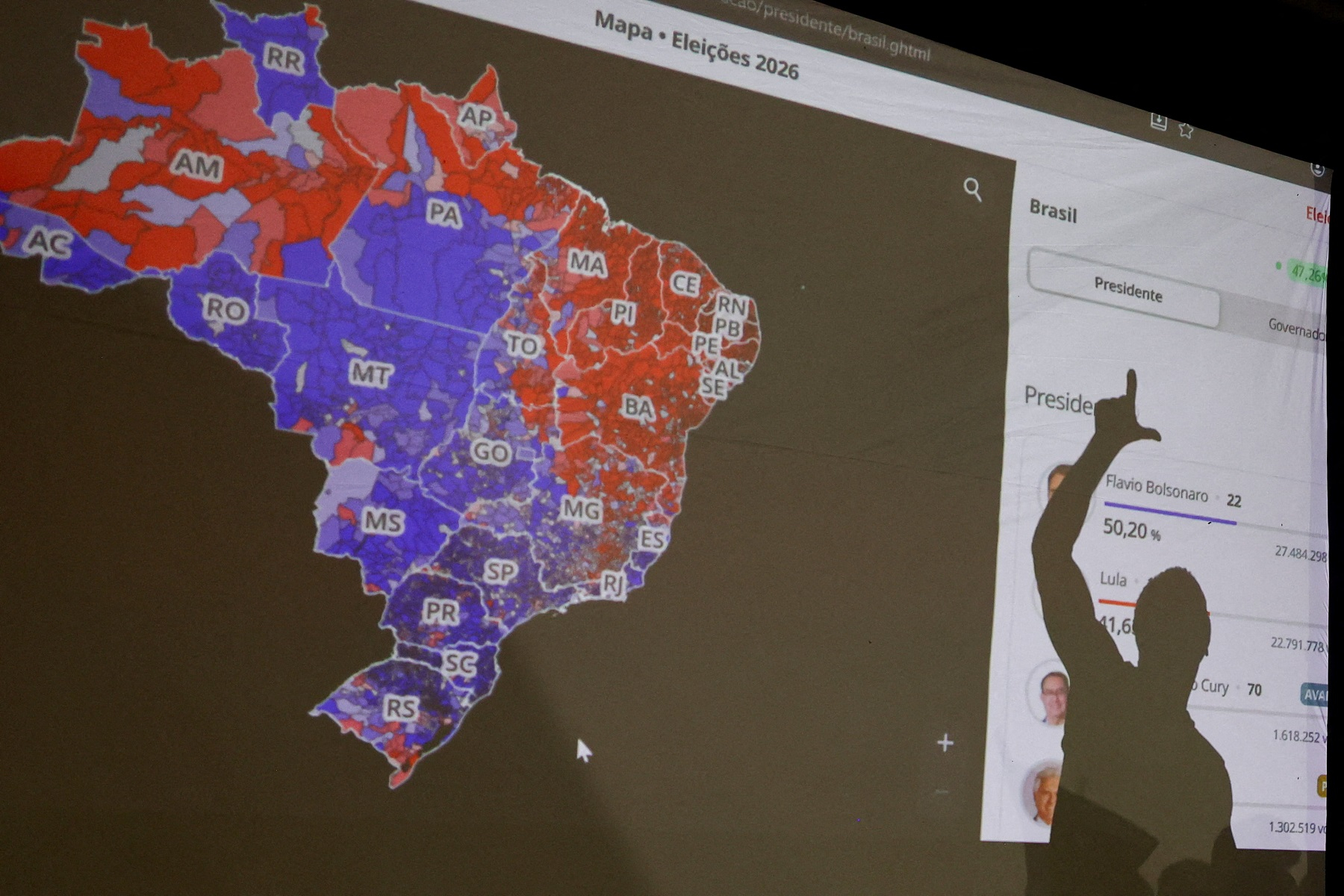
Right-wing senator Flavio Bolsonaro finished ahead of Brazilian President Luiz Inacio Lula da Silva in Sunday's election in which neither scored a majority, sending the tight race to a run-off in three weeks.
In a surprise result that defied opinion poll projections showing Lula in the lead, Flavio Bolsonaro scored 47 percent of the vote to the incumbent's 45 percent.
If Bolsonaro triumphs in the October 25 election, the Latin American powerhouse will join a steady rightward march in the region in recent elections, a trend championed by US President Donald Trump.
The election results included a series of landslide wins for the right in parliament in a massive setback to Lula, who at almost 81 is seeking a fourth term in office to cement his legacy.
"I admit I was convinced I would win in the first round. The game is about to start. In extra time, we will win over the Brazilian people," the 80-year-old said. "I'm very good at knockout stages."
The veteran leftist has branded the election a battle between democracy and "barbarism," warning voters that Brazil's sovereignty was at stake in the face of US pressure.
Flavio Bolsonaro was a little-known senator a few months ago when his father anointed him his political heir, unable to run himself as he serves a 27-year sentence for an attempted coup after losing a 2022 election bid.
However, his father's powerful name won over the country's conservative base and he slid past Lula despite a campaign marked by scandals and mudslinging.
"I am truly happy with the result," Flavio Bolsonaro said after results came through, hailing the "very real possibility" of a run-off victory.
Voters in the deeply polarised nation were jaded by familiar choices, and few voted with conviction.
Oscarina de Oliveira, a 62-year-old caregiver, said she had planned to vote for Lula, as she always has. But "when I got there, I switched to Bolsonaro. Just to see what happens, to see if anything changes."
It emerged during the campaign that Flavio Bolsonaro was under investigation for corruption over the financing of the biopic "Dark Horse" about his father.
For many voters, this did little to move the needle. With 56 million votes, his first round performance outdid that of Jair Bolsonaro in 2018, when he was elected, and 2022.
"Things are truly terrible. As far as I'm concerned, the left just doesn't work anymore," said tech worker Joao Batista, 36, in the Rocinha favela, saying he was fed up with the "horrible" expense of basic goods.
Flavio Bolsonaro on Sunday highlighted that as president, he will have the possibility of appointing four justices to the powerful Supreme Court – which convicted his father and has been at the centre of key political and criminal scandals.
The elections proved a triumphant comeback for the Bolsonaro family after Jair Bolsonaro lost a re-election bid in 2022, leading to violent riots in the capital and his conviction last year for attempting a coup.
Former first lady Michelle Bolsonaro and another one of Jair Bolsonaro's sons, Carlos Bolsonaro, both secured seats in the senate. Jair Bolsonaro's youngest son Jair Renan, 28, was elected as a federal lawmaker.
Flavio has cast himself as more "moderate" than his firebrand father, but his critics were concerned.
"Flavio is a danger to Brazil, he represents a step backward. We can see everything his father did...He really destroyed Brazil," said Anderson de Almeida, a 45-year-old doorman.
Trump had said he was watching the election "very closely," but did not endorse Flavio Bolsonaro. The US president has wielded tariffs and sanctions to pressure Brasilia over complaints ranging from the trial against his ally Jair Bolsonaro to alleged unfair trade practices.
Lula repeatedly warned him not to "meddle" in the elections. Revered for social welfare programs that lifted millions out of poverty, Lula made a dramatic comeback to office in the 2022 elections after being jailed on a corruption conviction for 18 months. The charges, thrown out on procedural grounds, have continued to haunt him.
In his third term he oversaw a drop in inflation and unemployment, but voters complain about a high cost of living and as in many Latin American nations, citizens are fed up with high levels of crime and violence. (AFP)
_____________________________
Last updated: 2026-10-05 HKT 10:05
Edited by Cecil Wong
Brazil's presidential election heads to runoff
2026-10-05 HKT 08:34
Share this story


Jamie Clarke reports

