


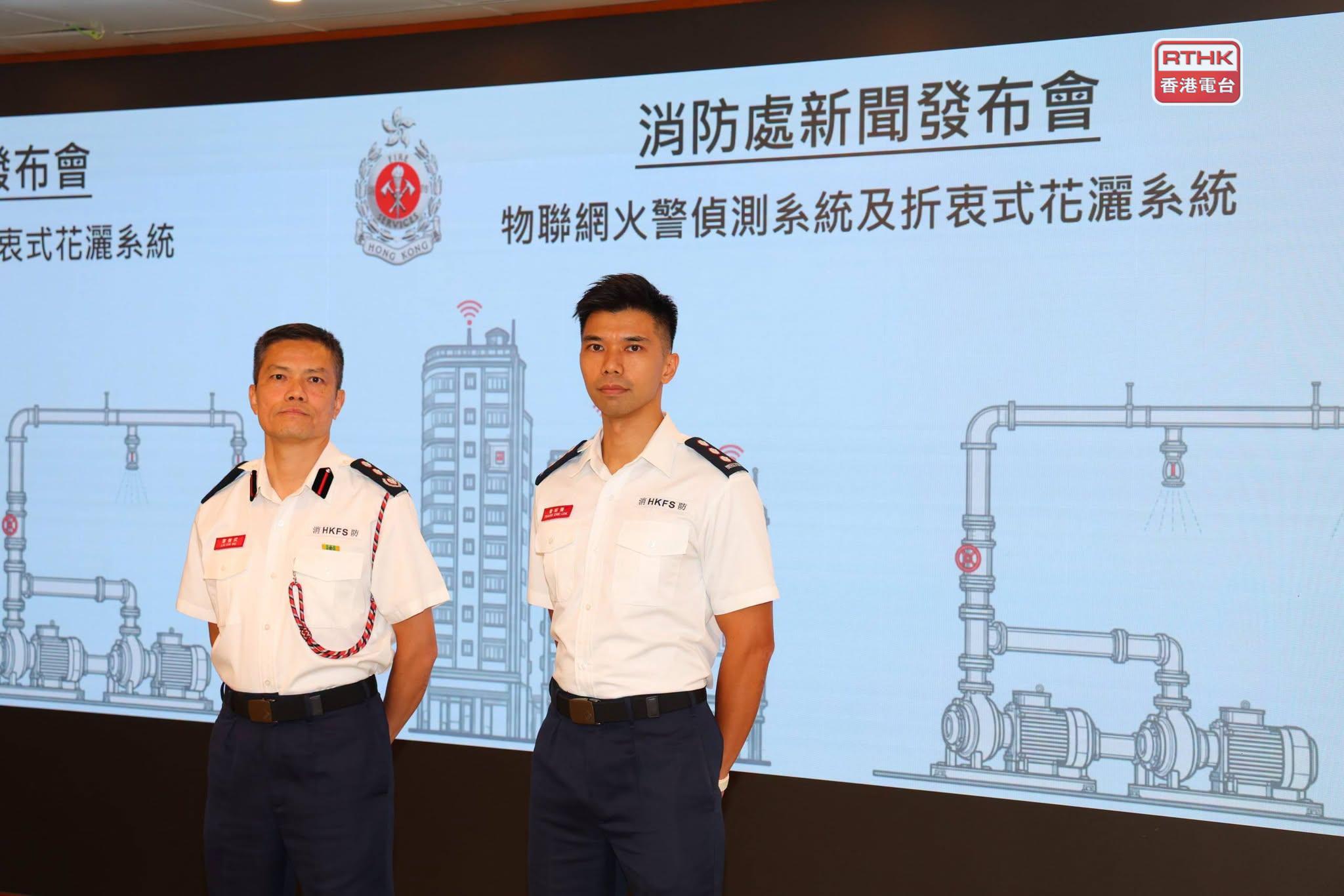
The Fire Services Department (FSD) wants to speed up fire safety equipment upgrades at thousands of high-rise buildings by allowing smart devices and portable extinguishers.
Since 2007, authorities have inspected thousands of buildings built on or before March 1, 1987 to see whether their fire protection installations and equipment met modern standards.
Owners of buildings requiring upgrades will be served notices, and those who fail to comply face fines.
But the FSD noted that many ageing buildings lack the space or resources to install manual fire alarms and hose reels.
That prompted the rise of alternative solutions, namely the "Internet of Things (IoT) fire detection system" and portable extinguishers.
Equipped with carbon monoxide and smoke sensors, the IoT system automatically alerts the FSD via the 4G cellular network in a fire.
Following a pilot scheme, the system was officially approved for use in buildings of six storeys or below from April this year.
But from October onwards, the arrangement will be expanded to taller towers, covering around 6,000 buildings.
Acting deputy chief fire officer Lai Kin-mo said under the alternative approach, buildings of seven to 12 storeys will no longer have to install fire hydrants and hose reels.
Instead, they only have to make sure their dry fire mains function properly, while two portable extinguishers are placed on each floor.
As for even higher buildings of 13 storeys or above, they can install IoT sensors on their existing fire pumps and water tanks to spare the need for a backup pump.
"In the past, buildings only had a manual fire alarm system. When a fire broke out, it required manual activation by residents to ring the alarm and send a signal to us," Lai said.
"But if buildings adopt the alternative approach and install the IoT fire detection system, it will automatically detect the fire and alert us immediately."
Lai said the new system could cost as little as HK$500,000, compared with up to HK$2.6 million for traditional ones, and the works could be completed in two to four weeks.
Nine approved contractors are now ready for hire, up from five previously.
Edited by Raymond Yeung
Smart fire systems now a go at high-rise buildings
2026-10-14 HKT 21:47
Share this story


