


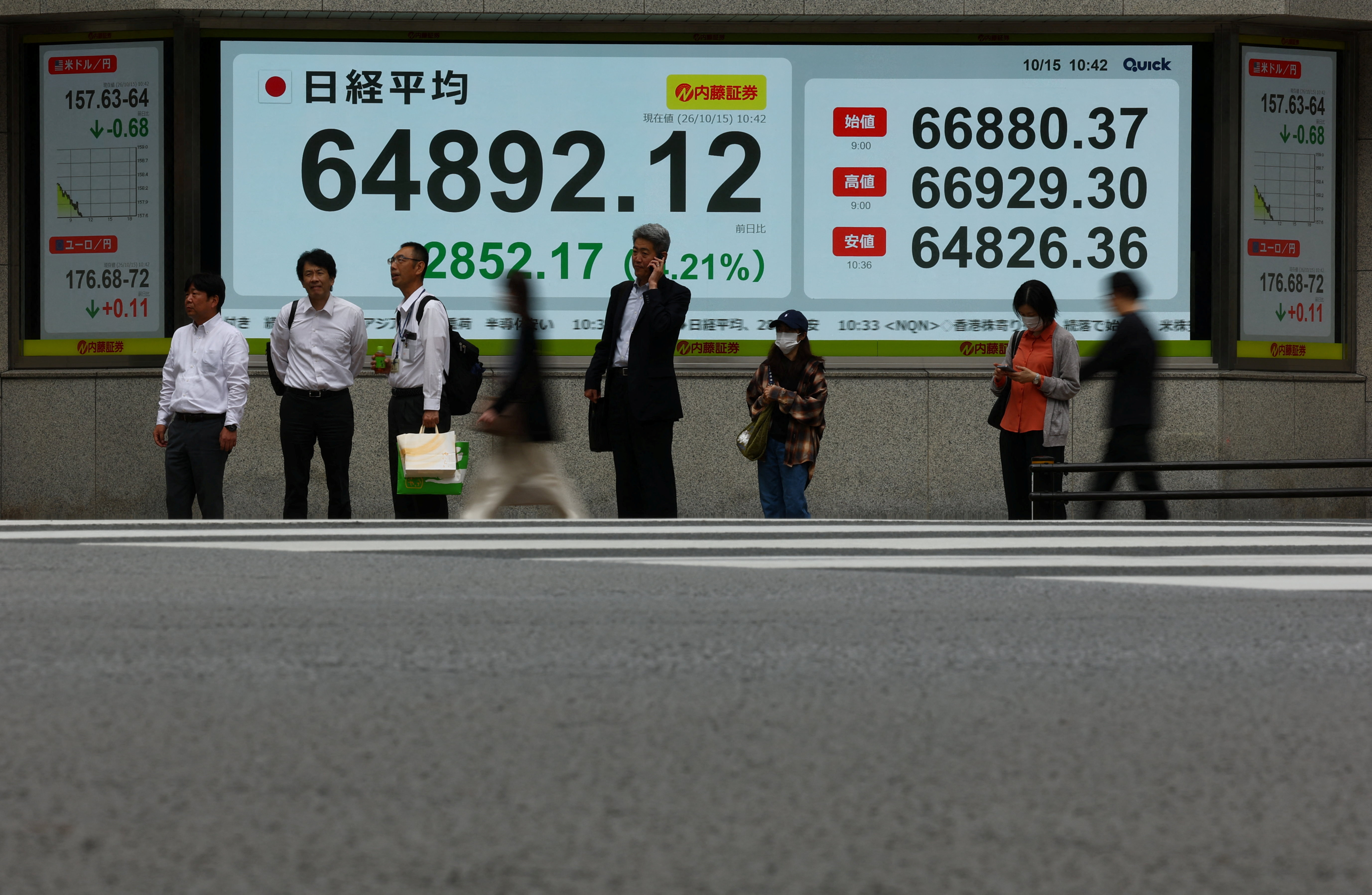
Asian share markets slipped on Monday as unease over AI's enormous funding needs undermined confidence ahead of a week packed with earnings, while the euro eased in the wake of rioting across France.
A fall in oil prices offered some support to bonds and Wall Street stock futures, limiting Asia's losses.
Oil fell following US President Donald Trump's decision to waive some sanctions on Russia, though he later said a final decision on the matter had not been made.
US Secretary of State Marco Rubio said on Saturday that the president would take up to 60 days to assess the economic impact of such a move.
Brent futures still fell 1.6 percent to US$108.06 a barrel, while US crude futures lost 0.7 percent to US$100.70 a barrel.
Meanwhile, Iran reported another tanker had hit a mine in the Strait of Hormuz.
Geopolitical tensions combined with safe-haven flows from equities to extend a rally in sovereign bonds, with 10-year Treasury yields down three basis points at 5.0645 percent, having just recorded their largest weekly fall in over eight months.
All of this helped S&P 500 futures edge up 0.5 percent, while Nasdaq futures rose 0.8 percent.
Asian markets were hampered by concerns about tech; Japan's Nikkei fell two percent after losing 5.4 percent last week as the tech sector took a beating.
South Korea dropped 1.6 percent, having shed more than 14 percent last week.
MSCI's broadest index of Asia-Pacific shares outside Japan eased 0.3 percent.
"Investors have long worried that AI revenues won't be sufficient to recoup the massive upfront investment, while AI infrastructure may need to be written down as it ages and depreciates in the meantime, which lowers book value massively," said My Bui, an economist at fund manager AMP.
"Rising government bond yields and wider corporate credit spreads are increasing financing costs, making it harder to borrow, refinance, and keep the AI infrastructure build-out going."
Meanwhile, Indonesian markets face a tense start on Monday after a warning from MSCI over possible expulsion from some of its indexes next year rattled already fragile investor sentiment and sparked a furious selloff in the world's worst-performing stock market.
Jakarta stocks sank 11.6 percent on Friday, the benchmark's biggest one-day drop in nearly three decades, taking year-to-date losses to 40 percent, after MSCI said it was considering shifting Indonesia to "standalone" status from its current "emerging markets" mantle.
The index provider had threatened a downgrade to "frontier" status in January because of opacity in ownership and trading behaviour but said on Friday the lack of progress in remedying those concerns meant even a downgrade to that status would not reflect the severity of the issues. (Reuters)
Edited by Tony Sabine
Asian markets make jittery start to Monday
2026-10-19 HKT 09:16
Share this story


