


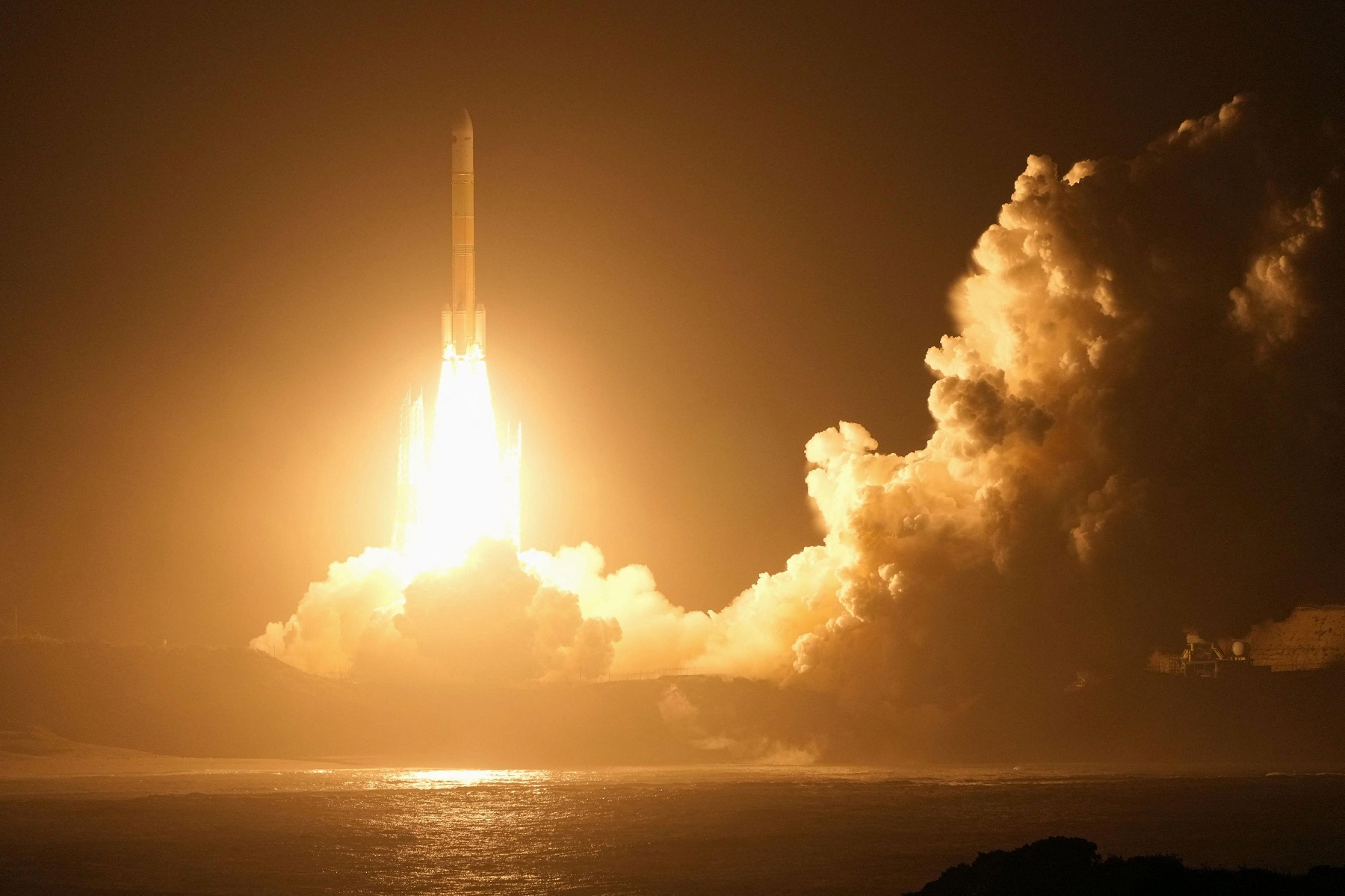
Japan launched an uncrewed spacecraft toward the Martian moon Phobos on Tuesday on a mission intended to become the first to collect samples from the small rocky body and return them to Earth for analysis.
The Japan Aerospace Exploration Agency's Martian Moons eXploration spacecraft lifted off aboard an H3 rocket before dawn from the Tanegashima Space Centre in southwestern Japan.
The spacecraft is expected to reach Mars in August 2027 and return samples to Earth in 2031. Jaxa hopes the mission will shed light on the origin of the two moons of Mars and deepen the understanding of our solar system's early stages.
Jaxa aims to collect at least 10 grammes of material from its surface and return it to Earth for analysis.
The launch marked the first interplanetary mission for Japan's H3 rocket. The country's flagship launcher experienced a high-profile failure on its inaugural flight in 2023 when its second-stage engine failed to ignite, but has since completed a series of mostly successful launches.
The mission – which aims to be the first round trip to the Martian region – is a collaboration with US and European space agencies, as well as numerous universities and tech companies.
Those involved hope it will help lay the groundwork for eventual human exploration.
Jaxa hopes the mission will reveal how Mars and its two moons formed, a key piece of knowledge in working out how the Solar System was born.
One theory for the origin of the moons – the "giant impact" hypothesis – is that they formed after a celestial body collided with Mars.
The "capture" hypothesis, meanwhile, postulates that the moons are asteroids pulled in by Mars's gravity.
Determining which theory is correct will help reveal "how a habitable environment for life might have arisen on the terrestrial planets", Jaxa said, referring to the four rocky worlds closest to the Sun – Mercury, Venus, Earth and Mars.
Jaxa said the mission will also explore the possibility of using Phobos as a "natural space station" by establishing the requirements for a round trip – something "essential for crewed Mars exploration."
It will also observe the planet's other moon, Deimos, although it will not land on it.
US and Chinese space agencies have also been vying to be the first to return rock samples from the surface of Mars back to Earth.
Nasa's Perseverance rover, which has been roaming across Mars since 2021, has already collected samples.
The return mission, however, was effectively cancelled by the administration of US President Donald Trump following a vote by Congress in January.
China's Tianwen-3 spacecraft is scheduled for launch around 2028 and hopes to return Mars samples to Earth as early as 2031 – potentially before the Japanese mission's return. (Agencies)
Edited by Cecil Wong
Japan sends rocket on world first Mars moon mission
2026-10-20 HKT 07:28
Share this story


