


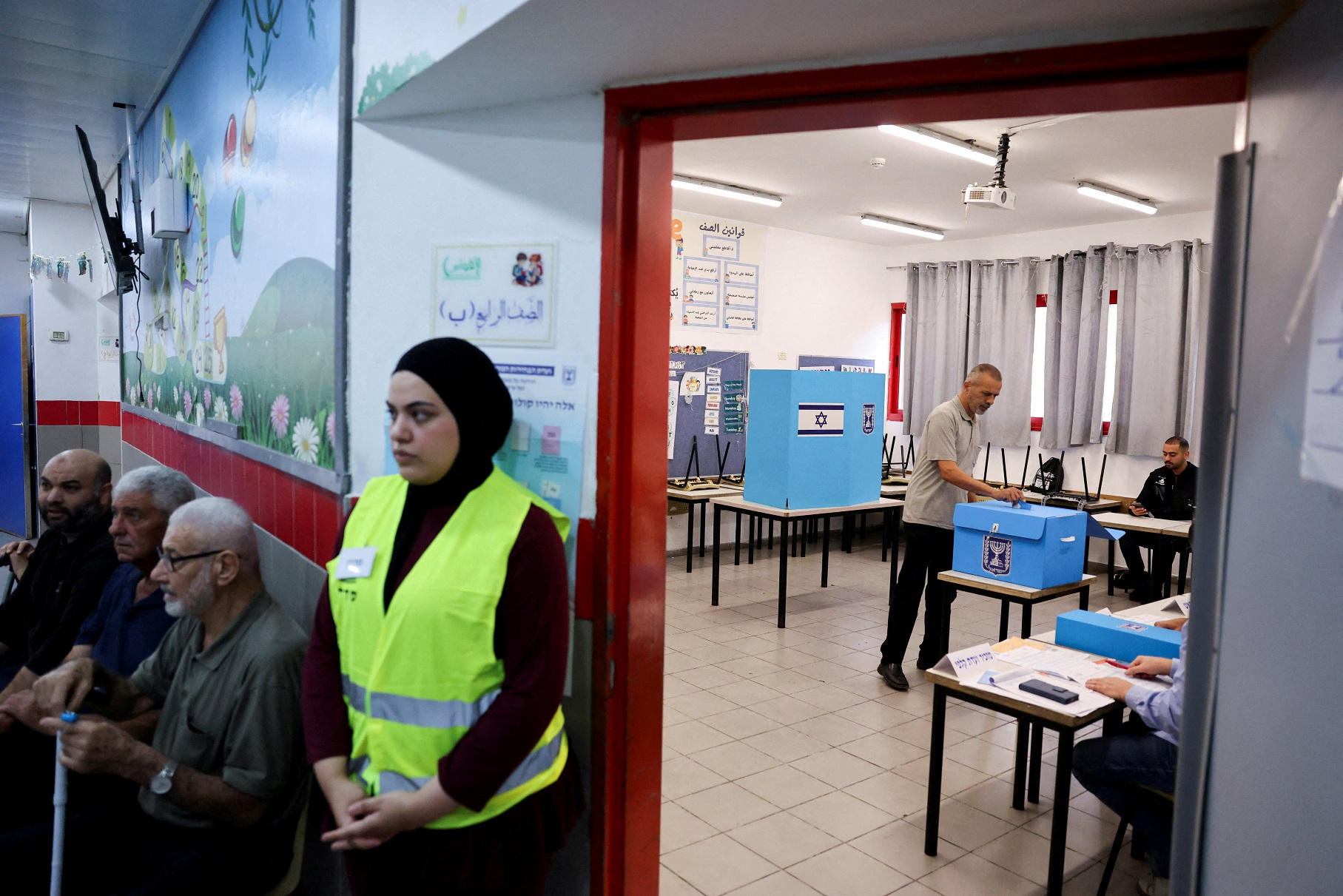
Israeli Prime Minister Benjamin Netanyahu faces a fight for political survival on Tuesday in an election seen by many Israelis as the most consequential in the country's history and a referendum on his leadership since the 2023 Hamas-led attacks.
The vote follows a turbulent period for Israel, shaped by the trauma of the October 7 attacks, wars in Gaza, Lebanon and with Iran, deepening international isolation, and the divisive policies of Netanyahu's right-wing coalition.
Yet Netanyahu, Israel's longest-serving leader with 19 years in office, remains a formidable survivor, with nationalist politics increasingly entrenched and Israel's fragmented system potentially leaving him best placed to form a government.
Opinion polls show a close race between Netanyahu's Likud Party and its right-wing allies and a rival alliance led by Gadi Eisenkot, a former military chief of staff and security hawk with backers on the right and in the centre.
Voters began casting ballots after polling stations opened at 7am (0500 GMT).
The polls close at 10pm (2000 GMT).
Netanyahu has campaigned on his wartime leadership and his alliance with US President Donald Trump, who has endorsed him and joined Israel in waging war on Iran.
Netanyahu said on Sunday that Trump was prepared to act again to "finally" remove the Iranian threat, but only if Netanyahu remained in power.
Eisenkot has accused Netanyahu of "relying on a campaign of fear-mongering, lies and threats" and said he was confident Trump would work "in full cooperation with any leader chosen by the people".
Netanyahu may again depend on far-right leaders Itamar Ben-Gvir and Bezalel Smotrich to form a government.
Both have faced sanctions from some Western countries that accuse them of inciting violence against Palestinians, while Ben-Gvir's Jewish Power Party has gained support in opinion polls.
Neither Netanyahu nor Eisenkot has a clear path to power.
If neither can form a governing coalition in the 120-seat parliament, Netanyahu could stay on as caretaker until another election is held next year.
The Israeli Central Election Committee said 7.3 million Israelis are eligible to vote, some 330,000 of them for the first time.
For many of Netanyahu's opponents, the election turns on accountability for the security failures of October 7, Israel's deadliest day.
Opposition groups have promised a national inquiry.
Eldad Shaaltiel, a volunteer with Eisenkot's Yashar Party, said he had come early to hang campaign posters outside a Jerusalem polling station, aiming to sway the potentially critical pool of still wavering voters.
Some 13 percent of Israeli voters have yet to decide how they will vote, according to data collected by the Viterbi Family Centre for Public Opinion and Policy Research at the Israel Democracy Institute.
Nilli Mor, a volunteer for the Democrats Party led by former general Yair Golan, another opponent of Netanyahu, said she was campaigning "to try and bring a new day to Israel, a better day with hope and great change for this country".
A high turnout among voters from Israel's Arab minority – Israeli by citizenship but Palestinian by heritage – could help nudge Israel's complex coalition arithmetic in favour of Eisenkot.
Though Eisenkot has ruled out partnering with Arab parties, citing a lack of shared values, analysts see a scenario where they could prop up a minority government he leads in order to ensure Netanyahu is removed from office.
But Ben-Gvir, casting his vote in the Kiryat Arba settlement in the occupied West Bank early on Tuesday, predicted Netanyahu would return as prime minister, adding: "We will serve as the right-wing anchor of that government".
In some bastions of Likud support, disenchanted voters have been going door to door to turn voters against Netanyahu.
Some have turned away from Netanyahu as he battles corruption charges he denies in a long-running criminal trial.
"My expectation is that we will have only a slight majority either way. No landslide," said Israeli political analyst Amotz Asa-El of the Shalom Hartman Institute. (Reuters)
Edited by Tony Sabine
Polls open in Israel as Netanyahu battles for survival
2026-10-27 HKT 17:01
Share this story


