


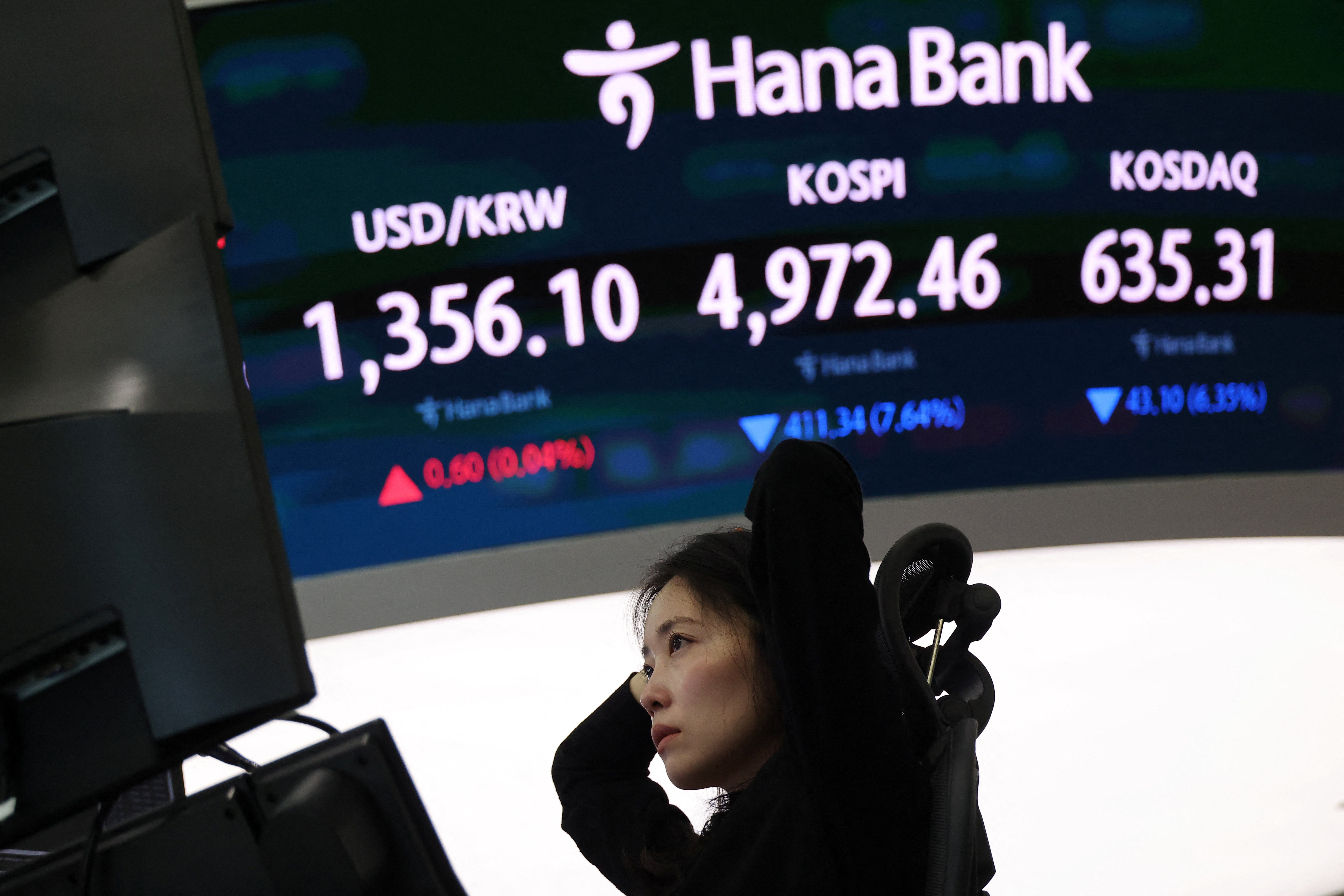
Mainland and Hong Kong stocks fell on Friday as a Nasdaq-led tech rout rippled across Asia and fuelled fears the AI boom is losing steam, although bargain hunting helped pare losses in markets across the border buoyed by Beijing's market-supporting measures.
In Hong Kong, the benchmark Hang Seng Index ended 315 points, or 1.3 percent, in the red at 24,481 on turnover of HK$247.43 billion but registered a 5.1 percent weekly gain, its best since March 2025.
The tech index fell 76 points, or 1.8 percent, to 4,078 but posted its best weekly gain since February 2025, advancing 8.6 percent, while the China Enterprises Index was 94 points, or 1.1 percent, lower at 8,274.
Up north, the blue-chip CSI 300 Index dropped 1.4 percent but notched up a 1.7 percent gain for the week to snap a 12-week-long losing streak.
The Shanghai Composite Index ended down 40 points, or 1.1 percent, at 3,649 on turnover of 772.63 billion yuan but broke a six-week losing streak to end the week 1.4 percent higher.
The Shenzhen Component Index fell 295 points, or 2.57 percent, to 11,175 on turnover of 885.16 billion yuan while the ChiNext Index dived 101 points, or 3.96 percent, to 2,465 on turnover of 441 billion yuan.
Tech sectors across Asia took a heavy blow after a steep selloff overnight in the United States wiped trillions of dollars off market value, as investors fretted that a Democratic sweep in the US midterm elections could bring tighter scrutiny of the AI sector.
China's tech-focused Star 50 index and the AI index slumped up to 5.2 percent before paring some losses.
Dong Baozhen, chairman of asset manager Lingtong Shengtai, said the overnight slump in US tech stocks meant the logic behind the AI-driven rally had crumbled.
"The US stock market has been the standard-bearer and backbone of the global AI bull run. Now that backbone has snapped. Can AI bull markets elsewhere hold up on their own?" he said.
Chinese AI hardware stocks with significant exposure to the US market were among the hardest hit. Zhongji Innolight, which makes optical transceivers for data centres and generates most of its revenue in America, slumped 9.2 percent to a one-year low. Rival Eoptolink Technology tanked 7.3 percent.
Jason Hsu, founder and chairman of Rayliant Global Advisors, said China's sentiment-driven stock market was heavily influenced by AI stock performance in the United States.
Technology stocks carry significant weight in China's stock market and "what people are really watching closely is whether AI in the United States is a bubble," he said, adding that any signs of a bubble bursting in the US "obviously will affect the Chinese market".
Still, early panic selling drew in bargain hunters, helping trim losses after Beijing rolled out support measures and reiterated its commitment to preventing systemic risks.
"The series of domestic support measures introduced recently should provide a degree of support within a trading range and help reduce the risk of a systemic downturn," said Ailsa Liao, senior analyst at Forthright Securities.
Some analysts, however, cautioned that the measures might not be enough to insulate the market from external shocks.
"I don't think China can completely escape the fallout from Wall Street, especially with selling this aggressive," said Pepperstone strategist Dilin Wu.
In Tokyo, the Nikkei ended down 3,643 points, or 5.96 percent, at 57,434 for the day and 9.3 percent for the week, its worst in more than six years amid worries new political equations forming in the wake of the US midterms could weigh on AI development. The broader Topix lost 232 points, or 5.9 percent, with all 33 industry sectors sliding.
In Seoul, the Kospi plunged 324 points, or 6.02 percent, to 5,059, a day after dropping 5.3 percent. The South Korean benchmark, down 11.7 percent for the week, has dropped 44 percent from its June peak but is still up 20 percent so far this year. (Agencies)
Edited by Aaron Tam
HK stocks slip as tech rout spreads to Asian markets
2026-11-06 HKT 17:16
Share this story


