


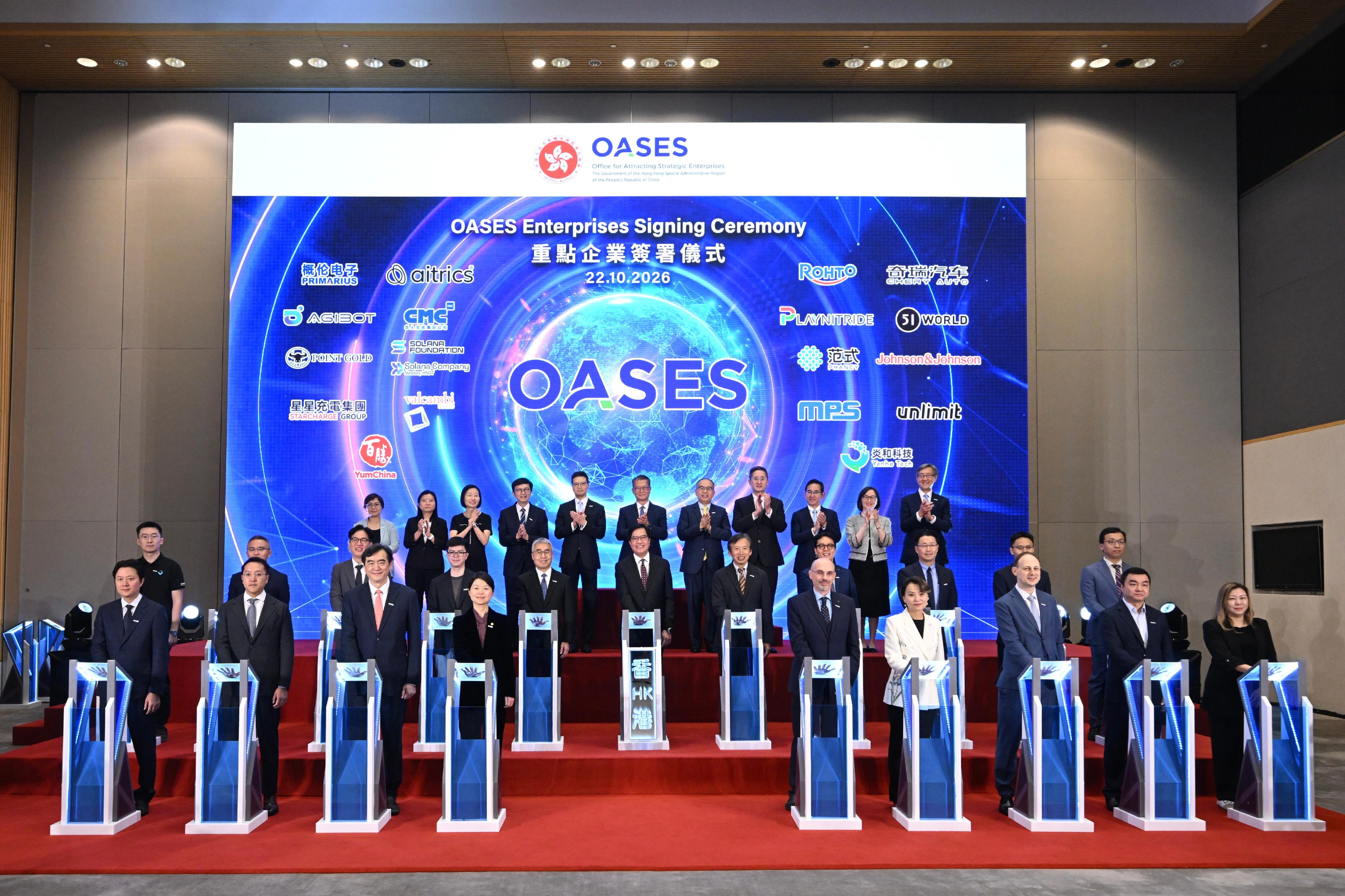
The United States is the largest source of overseas firms in Hong Kong’s latest batch of companies welcomed by the Office for Attracting Strategic Enterprises (Oases).
Last month, Oases welcomed 18 enterprise partners in its seventh batch, bringing the cumulative number of strategic enterprises attracted to Hong Kong to 142.
"In terms of overseas enterprises, you may be a bit surprised, but the United States has the largest number; of course there is also Europe," said Oases director-general Peter Yan on an RTHK radio programme on Saturday.
"This time I am also very happy that for the first time we have a Korean enterprise coming to Hong Kong and also a Japanese enterprise coming to Hong Kong as strategic enterprises."
On the mainland side, Yan said the enterprises came from various cities such as Beijing, Shanghai and Shenzhen.
"This time we also explored more other cities that are quite outstanding, especially in advanced manufacturing and new energy; we are also attracting them," he said.
"In medical technology, other cities are also developing quite well – for example, Hangzhou in AI, and Nanjing and Suzhou."
Yan said artificial intelligence and life and health technology are two relatively large sectors represented in the batch, with each accounting for about 30 percent of the total, while fintech and new energy each accounted for more than 10 percent.
The 142 strategic enterprises that have settled in Hong Kong, he enumerated, have committed to a total investment of HK$84 billion and will create about 26,700 high-end jobs.
His office has been monitoring and following up on the companies’ development, and both capital investment and job creation have now exceeded their targets.
Looking at the first six batches of strategic enterprises, Yan said capital investment has exceeded pledged figures by about 30 percent.
He added that Oases carefully selects strategic enterprises, gaining an in-depth understanding of about 20 to 30 percent of the companies it contacts and helping them draw up development plans for Hong Kong.
Typically, the office contacts companies several months before they settle in the city and follows up for more than a year, discussing their first concrete landing project and matching them with policies or stakeholders such as universities, investors and the business sector to help ensure a tangible industrial contribution.
Edited by Robert Kemp
US enterprises 'surprise' in latest HK strategic batch
2026-11-07 HKT 13:08
Share this story


