


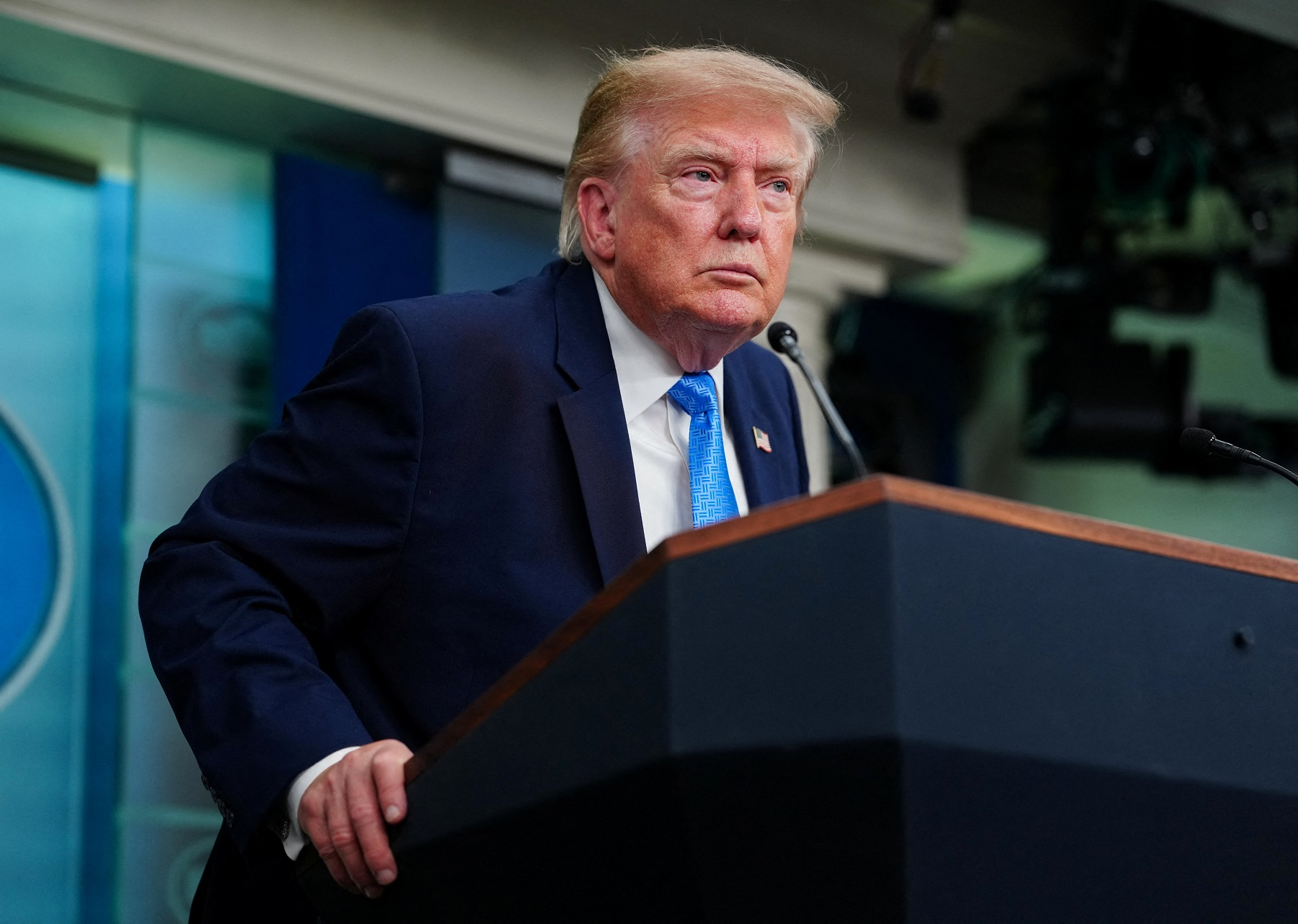
US President Donald Trump said on Monday he plans to hold off on new military strikes against Iran for the time being after appeals from countries in the region, including from Qatar's prime minister in White House talks.
Trump, in a Reuters interview and a later appearance in the White House press briefing room, said he plans to keep up a naval blockade in the Strait of Hormuz for now.
"The United States of America is fully locked and loaded with the best equipment ever made, and we don't think there's going to be any reason to use it," Trump told reporters.
He said he was acting "at the behest of countries that are their neighbours" and specifically cited Qatar, Saudi Arabia, the United Arab Emirates, Bahrain, Kuwait and others that prefer the US not launch new attacks.
Trump spoke after meeting with Qatari Prime Minister Sheikh Mohammed bin Abdulrahman Al-Thani, a key intermediary with Tehran, as efforts to end the war ramp up following last week's US midterm election.
More than eight months into the conflict he launched alongside Israel on February 28, Trump has played down the likelihood of major warfare restarting soon but remains unwilling to accept an existing Iranian truce plan. Senior US and Gulf officials have cast doubt on the chances of an imminent deal.
Mutual attacks continue, with the US striking Iran's Qeshm island overnight, according to Iranian state media, and Iran attacking tankers in the Gulf and Strait of Hormuz this month while its Yemeni Houthi allies have hit Saudi Arabia.
Al-Thani, who is both prime minister and foreign minister of Qatar, met Trump after visiting Tehran last week.
The prime minister called his talks with both Trump and Vice President JD Vance positive.
"Grateful for the positive discussions on reaching a deal and bringing peace to the region," he said on X.
Iranian security council chief Mohsen Rezaei said on X the US should "stop manufacturing fake news about imaginary talks" and that it was "time to surrender to the seven conditions Iran has repeatedly set out."
Iran's proposal to end the war involves an end to the US blockade of its ports, the lifting of some sanctions and a halt to bombing in return for Tehran stopping its own blockade of the Strait of Hormuz, with talks on its nuclear programme and other sanctions to follow.
The US has repeatedly rejected that plan, with Secretary of State Marco Rubio describing Tehran's conditions on Sunday as "outrageous and ridiculous and really not realistic."
Iran's Foreign Ministry spokesperson Esmaeil Baghaei defended the plan on Monday as the most reasonable offer on the table.
Senior US Republicans including Vice President JD Vance have blamed their party's losses in last week's elections on the Iran war. Despite the growing domestic political pressure to end the conflict, Rubio said he did not believe a diplomatic breakthrough was imminent.
A senior United Arab Emirates official, Anwar Gargash, echoed that view on Monday, saying a comprehensive political settlement between the US and Iran appeared difficult.
"We should... prepare for a long period of uncertainty in which neither a decisive resolution nor stable regional order can be taken for granted," he said.
Vance, who led the negotiations for a short-lived truce in June, will also meet Al-Thani, whose country has been a prime mediator since early in the war, conveying messages between the sides and proposing ways to bridge their differences.
Anxiety over the war has pervaded the region for months, and Turkish President Tayyip Erdogan said on Monday he had told Trump that Ankara did not want to see a new escalation.
"We emphasise at every opportunity that it is possible to resolve these issues through dialogue and diplomacy. Unfortunately, we see a negative shift once again. We are doing our utmost to prevent this," Erdogan told reporters. (Reuters)
Edited by Cecil Wong
Trump says Qatar, Saudi prefer peace in Iran conflict
2026-11-10 HKT 07:45
Share this story


