


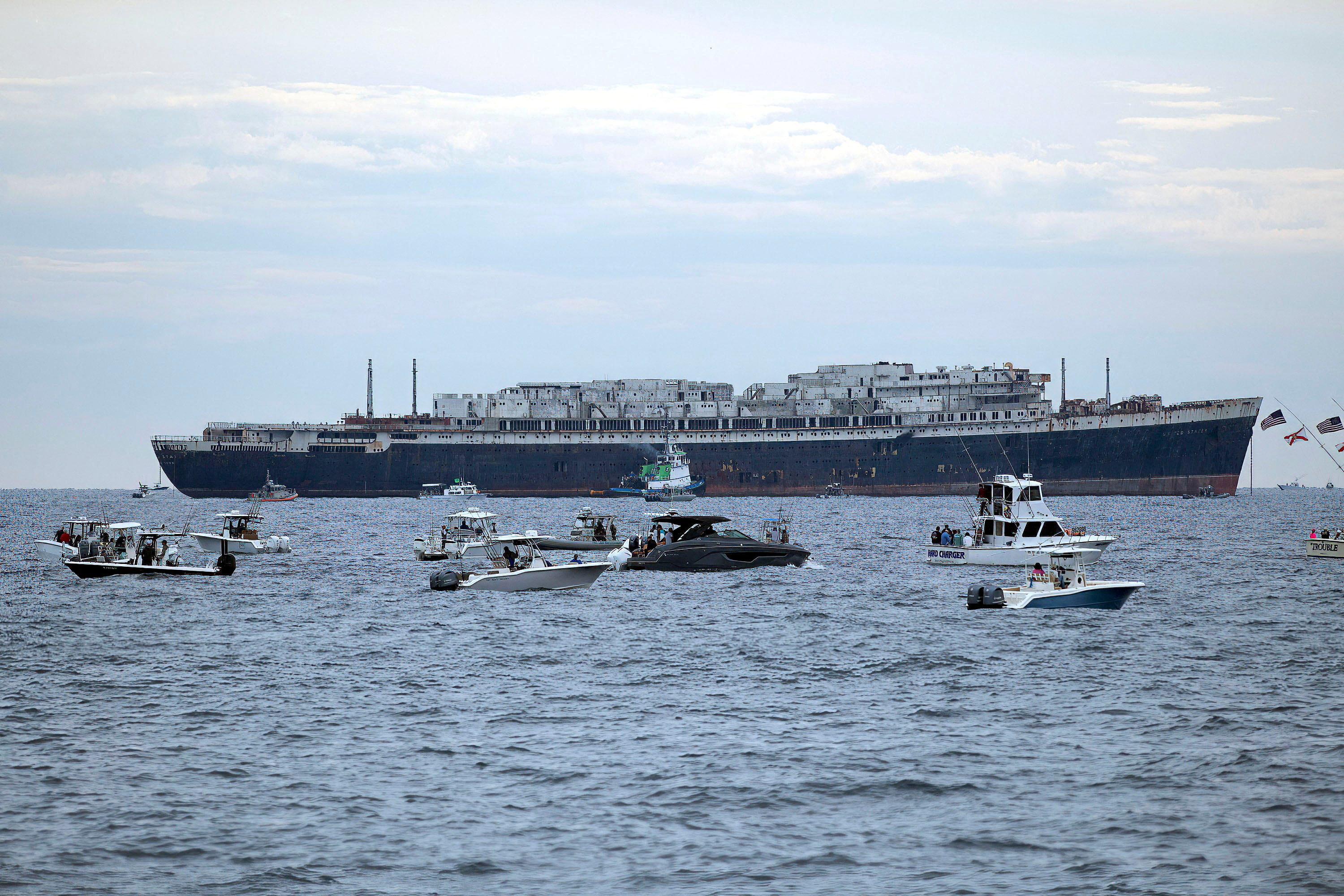
Famed ocean liner SS United States, the largest passenger ship ever built in America and the world's fastest, has hit the sea floor near Florida in a deliberate sinking designed to transform the vessel into the world's biggest artificial reef.
Wednesday's finale to a yearlong process preparing the ship to meet its destiny, 75 years after it was first launched at sea, was presented in a livestream with aerial views of the once-grand vessel's rusted hulk, stripped of its two smokestacks, quietly, slowly settling into calm waters of the Gulf of Mexico before succumbing to the deep.
The ship, measuring nearly 300 metres from stem to stern, was surrounded by onlookers and safety crews aboard dozens of tugboats and recreational vessels that accompanied the ocean liner as it was towed out to sea for its final voyage.
By then, work crews had spent months removing all environmentally unsafe materials from the ship, including residual fuel, wiring, glass, ductwork and other non-metal items, as well as any objects that could pose entanglement hazards for scuba divers.
The crews then cut holes strategically throughout the ship's hull and its decks to ensure that it would sink in a gradual, level and uniform manner, according to a fact sheet posted online by project organisers. No explosives were used.
Passageways were also cut through the 12 decks of the interior to allow for marine life to thrive in and around the ship on the sea floor.
If all goes as planned, the aging 20th-century vessel will come to rest upright on the gulf floor at a depth of almost 55 metres off the coast of Destin, Florida, a resort town and recreational fishing haven known for its white sand beaches and emerald green waters. The upper deck is expected to end up about 15 metres beneath the surface, organisers said.
The sinking process began at about 1pm but was so imperceptibly slow that the majority of the ocean liner's hull remained well above the surface as the sun set on the idle ship, surrounded by blinking lights of nearby vessels.
After hours, during which the waterline was seen creeping up the ship's hull inches at a time, the sinking accelerated as the sea poured through the holes cut into the lower decks and flooded the interior. In the final moments, livestream footage showed the ship abruptly listing to its port side before gently rolling into the sea and disappearing.
Warren Jones, a spokesman for the organisers, said the SS United States would probably take 30 to 60 minutes to reach the seabed once the interior compartments were all completely filled with water.
The SS United States, a wonder of post-Second World War oceanic luxury and engineering that carried the rich and famous across the Atlantic at speeds still unmatched, was retired from service in 1969 amid the rising popularity of commercial air travel.
The vessel sat moored for nearly 30 years in Philadelphia, seemingly destined to be sold for scrap, before authorities in Okaloosa County, in Florida's panhandle, stepped in to purchase the ship as part of a US$13 million project.
"We worked year after year to keep that ship from going to the scrap yard," said Jones, a boyhood passenger of the ship and representative of the SS United States Conservancy, a group that sold the ship to Okaloosa County.
After obtaining permission from the US Coast Guard and other agencies, the county had the vessel towed to a shipyard in Mobile, Alabama, where it was prepared for disposal at sea.
The SS United States will be in good company, joining a collection of more than 500 smaller underwater sites created from the remains of various sunken ships and concrete structures to create a divers' haven known as the Destin-Fort Walton Beach Artificial Reefs. (Reuters)
Edited by Aaron Tam
Famed ocean liner set to rule waves as artificial reef
2026-11-12 HKT 14:25
Share this story


