


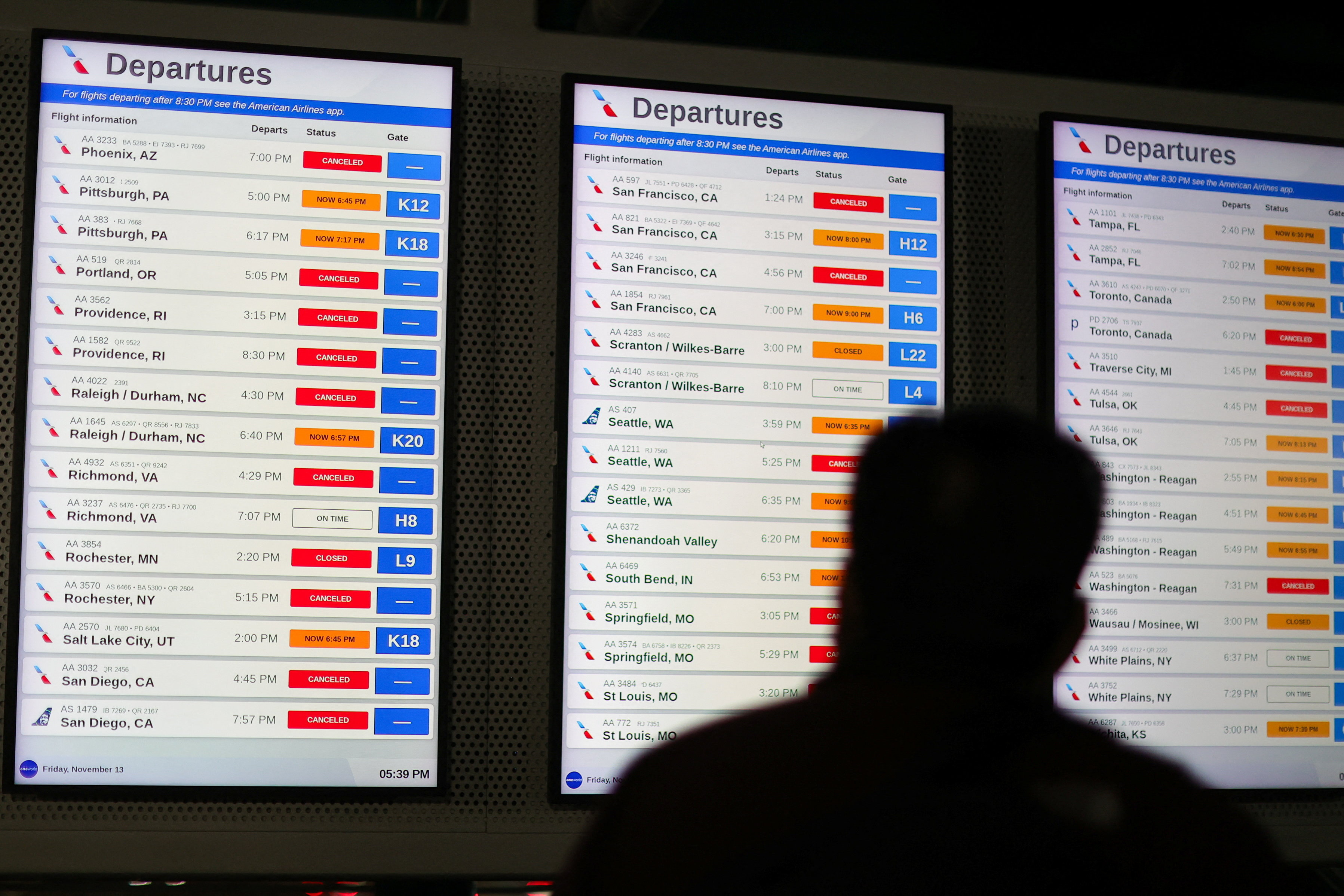
The US Federal Aviation Administration says airplane departures can resume after the agency lifted a nationwide ground stop caused by communications problems.
The green light for resumption came after the FAA had grounded all flights nationwide on Friday afternoon, causing hundreds of flights to be diverted. Officials cited “extraordinary circumstances” caused by communications problems at regional air traffic control centres.
The nationwide ground stop was the first since January 2023, when a key FAA computer system malfunctioned, and the second since the aftermath of the September 11, 2001, attacks.
Homeland Security Secretary Markwayne Mullin attributed the problem to a telecommunications outage and said there was no indication yet of a nefarious act. The consequences were profound, disrupting thousands of planned flights through at least late Friday night and upending travel plans for passengers.
“It’s frustrating. This certainly sounds like it’s going to be more than the usual run-of-the-mill delay. I look forward to finding out why,” said Jeff Dubner, a Washington attorney whose Alaska Airlines flight home from Los Angeles was already half an hour late and taxiing to the runway when the plane came to a halt.
The FAA was investigating a communication issue affecting the 22 regional air traffic control centres that direct planes en route between airports nationwide, said Transportation Secretary Sean Duffy.
International flights were being handled on a case-by-case basis, according to Mullin, with some seen taking off Friday evening. Meanwhile, some flights within Alaska and Hawaii were not impacted, Alaska Airlines said.
Mullin said at the White House that there was no indication yet that “this was a nefarious attack against us. It's just a telecommunications outage as of right now.”
“Everybody's safe. There's no reason to be concerned about your loved ones if they're flying,” he said.
At least 827 flights have been diverted so far as a result. As of 7.05pm EST, 8.05am on Saturday Hong Kong time, 670 flights were sent back to the airport from where they originally took off, while 157 were redirected to a different airport, according to Cirium, an aviation analytics company.
The airports where many of the flights ended up being diverted included Washington Dulles International, Los Angeles International, Cincinnati/Northern Kentucky International and Nashville International.
Some 11,000 flights carrying more than 1.5 million passengers were scheduled to take off from airports in the United States after 4pm EST, raising the likelihood of more cancellations and flight diversions.
United Airlines and American Airlines said flights already in the air will continue.
“It will be all hands on deck across American to get customers on their way as soon as possible when the FAA lifts this nationwide ground stop,” American said in a statement on the social platform X.
NBA, NHL and college teams were left stranded as they tried to reach their destinations. Meanwhile, NFL teams were left to wonder whether the issue would be resolved in time to travel to their games this weekend.
Cargo flights were also delayed by the ground stop.
FedEx, the world’s largest cargo airline, said it is prepared to activate contingency plans to keep any possible disruptions at a minimum.
US airlines move about 61,000 tonnes of goods – from letters to packages – to and from more than 220 countries daily, according to the industry trade group Airlines for America.
The government has been working to overhaul outdated technology
There is no timeline for restarting flights. Mullin said investigators will look at whether there is any link to the FAA's nationwide rollout of a new artificial intelligence system to help identify problems and reroute planes. But that system operates out of one location near Washington, DC, and just sends recommendations to the air traffic control centres.
The government has been working to overhaul the outdated technology that air traffic controllers rely on since Congress approved US$12.5 billion for the project last year. Miles of old copper wires have been replaced with fibre optic lines and old radio systems are gradually being replaced at airports across the country.
But much work remains. Duffy has said that another US$30 billion will be needed to complete the work, and the White House has begun lobbying Congress to approve it.
The problem appeared similar to a regional air traffic control communication outage in September that snarled hundreds of flights across the Northeast, aviation safety expert Steve Arroyo said, except this time on a nationwide scale. It may be linked to the outdated technology used by air traffic controllers.
“If you don’t have that ability, whether it’s because the old wires that they have are just run down or for whatever reason, you’ve got to stop airplanes on the ground,” said Arroyo, who is a former United Airlines pilot. “And not put them in the air where you’re going to risk not being able to communicate with them.” (AP)
Edited by Robert Kemp
US ends nationwide grounding of flights
2026-11-14 HKT 10:03
Share this story


