


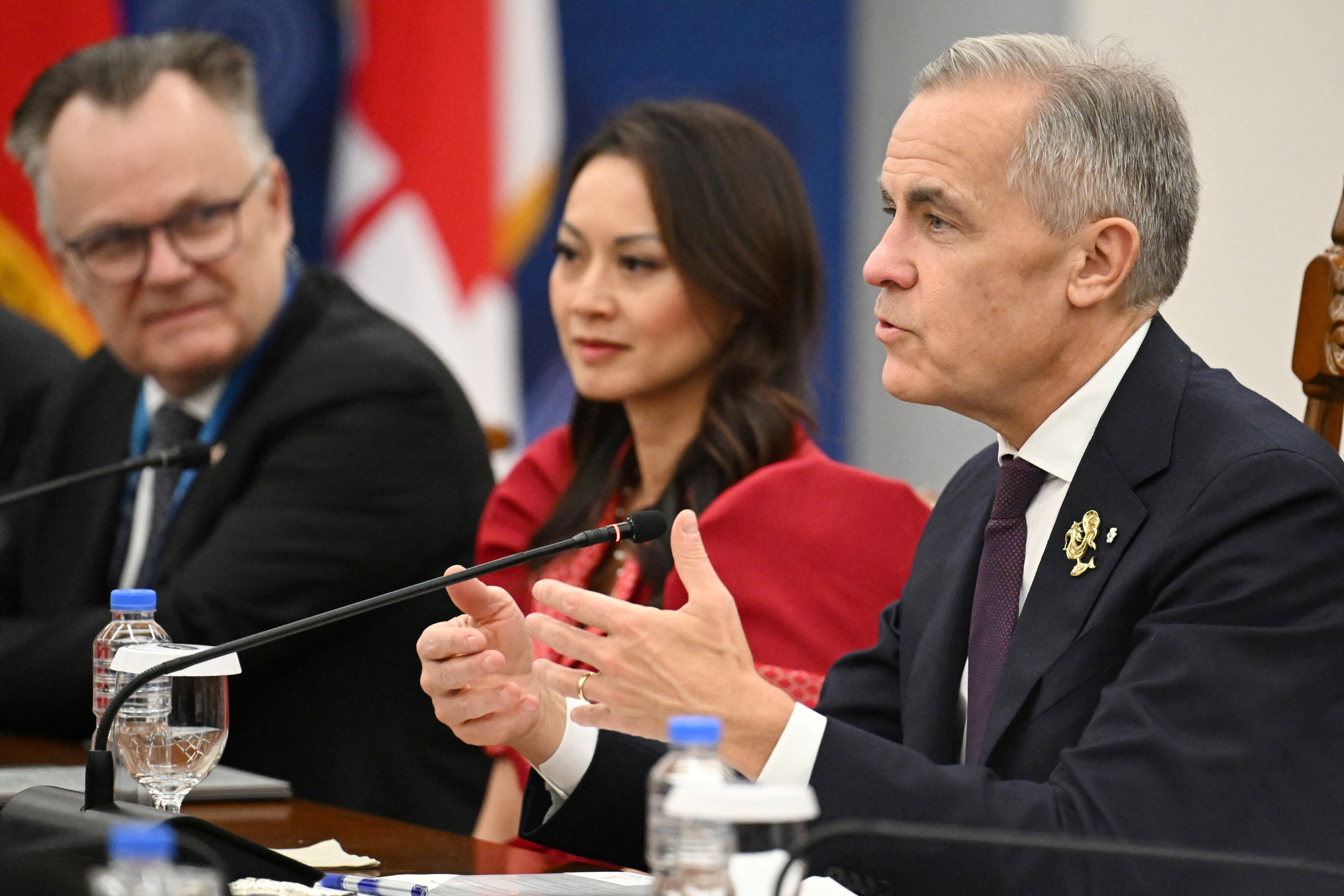
Canadian Prime Minister Mark Carney on Saturday said Ottawa had successfully concluded negotiations for a sweeping free-trade pact with the Philippines, as it seeks ways to reduce its reliance on the United States.
The US-Canada trade war has ruptured what was once one of the world's closest economic partnerships.
While Canada's trade surplus edged up in September, driven by higher oil exports, US President Donald Trump's tariffs also pinched multiple sectors, data showed.
The deal with the Philippines was about six months away from being signed, Carney said on the sidelines of a regional summit in Manila, where Trump is expected to arrive on Tuesday.
He added a broader agreement was also in the works with the entirety of the 11-strong Asean bloc, with those talks "substantially concluded".
The pacts were "part of a strategy of developing a dense web of reliable partners to create more opportunities ... and reducing our relative reliance on the United States," Carney said.
Calling the deal with Manila the "most comprehensive ... accord that the Philippines has signed," Carney said he expected trade between the countries to triple in the next decade.
Total trade between the two countries stood at about US$2.4 billion in 2025.
The deal will drop over 90 percent of tariff lines and cover areas ranging from agriculture to aerospace to artificial intelligence, Carney said without revealing specifics.
The deal with Asean, meanwhile, would be the "first trade agreement ... outside of Asia" for the bloc, Carney said, noting "more than US$50 billion a year in two-way trade, up nearly 25 percent in the past year".
In a separate statement, Manila said it expected the trade pact to be completed in the coming year.
The Canadian prime minister is on a multi-nation trip that will next take him to the Cambodian capital Phnom Penh for a biennial Francophonie summit before he heads north for the annual Asia-Pacific Economic Cooperation (APEC) meetings in Shenzhen.
There, Carney said, he will meet President Xi Jinping to discuss Canada's trade commitments with Beijing. (AFP)
Edited by Tony Sabine
Canada closes on free-trade deal with Philippines
2026-11-15 HKT 06:46
Share this story


