


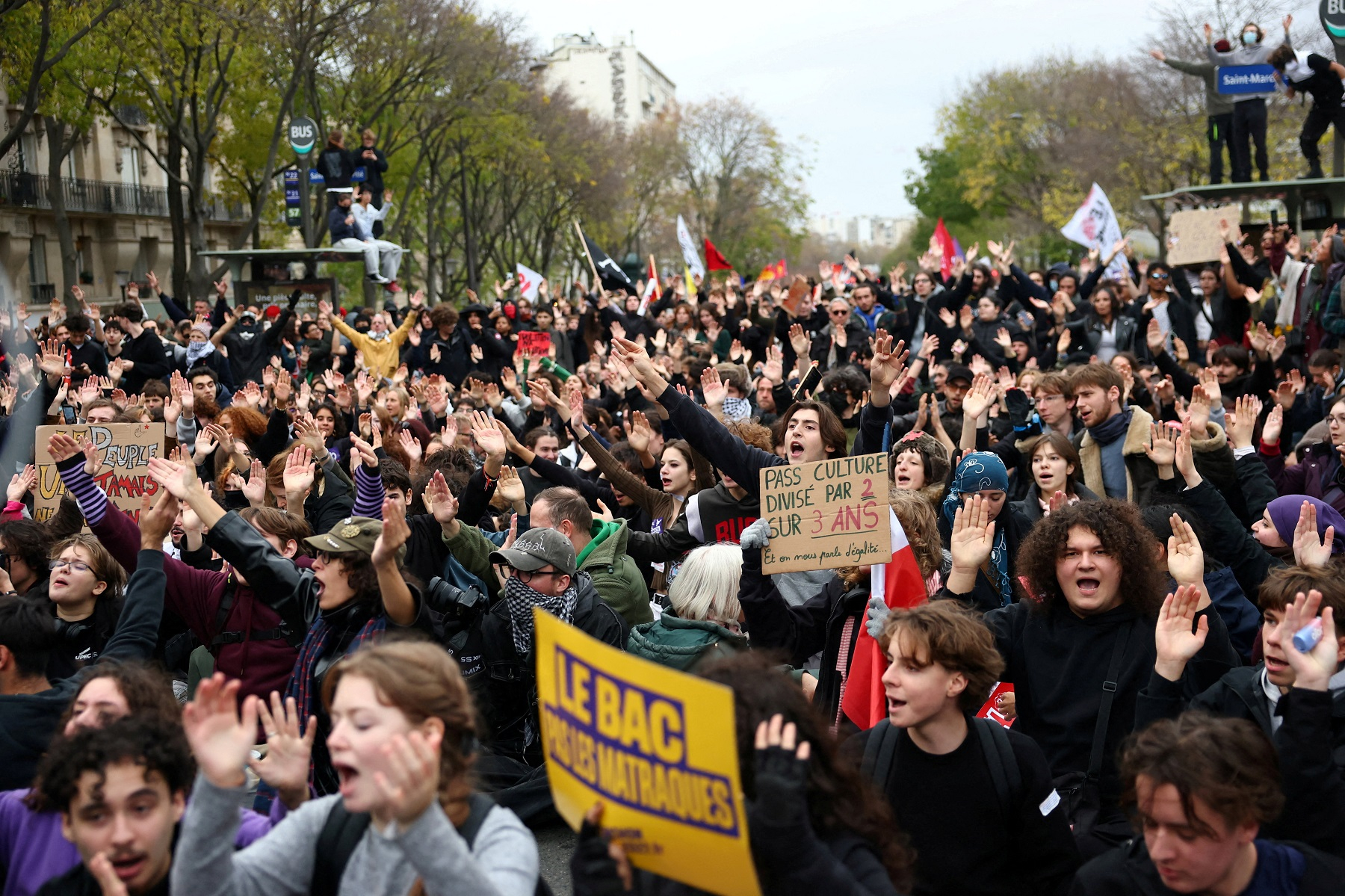
More than 100,000 people took part in protests across France on Tuesday after unions called a new nationwide public sector strike to demand pay rises.
High school pupils and university students joined private sector workers and retirees at the latest demonstrations to confront the government over the cost of living and other social concerns.
Unions said more than 500,000 people nationwide took part in the protests, including 175,000 in Paris, while the interior ministry put the total number at 146,000 around the country and 28,000 in the capital.
The European Union's second-largest economy has been rocked by more than a month of high school blockades and protests, as the government races to adopt a 2027 deficit-cutting budget ahead of a presidential election next year in which the far right is eyeing power.
In Paris, a march set off in a jubilant cacophony, with drummers decked out in sparkly pink and purple accompanying music blared from union vans.
The festive atmosphere continued through the afternoon, despite the multiple frustrations that drove people to the streets.
Nurse Aurelane Thos wore blue scrubs and marched with her colleague who carried a cardboard sign reading "Raise salaries."
"The state of schools, the state of hospitals, staffing levels in schools and hospitals, the way things are getting worse and worse across all public services – these are issues that really resonate with us," said the 38-year-old.
France's 5.8 million public sector employees were called to strike for the third time since September.
Talks with Prime Minister Sebastien Lecornu on Friday failed to satisfy unions pushing for pay rises after he announced a small boost to the minimum wage for private-sector workers.
The overall turnout was lower than on previous protest days.
"This is my second day on strike and I understand why there are fewer of us. It's a financial strain at the end of the month," said Emma, a contract worker for a local administration marching in Bayonne in southern France.
Young people showed up in force, after student organisations announced they were joining the day of action.
"We're stressed about our studies but when you have a bunch of cops in front of the high school every morning, you only want to keep protesting," said Mathilde, a 17-year-old pupil in Paris.
University professor Nicolas Prevot joined the demonstration in solidarity with young people, saying: "It's about defending human rights first and foremost, but also about protecting public services, which are being torn apart."
He and other protesters said it was critical to keep the far right out of power in the upcoming elections, at a time when opinion polls show a lead for the leader of the far-right, anti-immigration National Rally, Marine Le Pen.
Second in the polls is hard-left leader Jean-Luc Melenchon, who attended the Paris demonstration.
He said "repression was becoming harsher" towards young people, after multiple complaints of police brutality against teenagers, some of whom have lost eyes or hands.
The demands to bolster public services come as France is under steep pressure to cut its deficit.
In its draft 2027 budget, the government has ruled out any general public sector pay rise for the fourth consecutive year.
Unions put the loss of purchasing power for public servants at 16 percent since 2017.
Thousands gathered in Lyon in the southeast behind a banner reading: "Enough sacrifices for working people."
"I hope things will change, though I'm less and less hopeful about being heard," said university student Simon, 20.
"The government talks only about the minority of rioters and not about the real demands," he said of the authorities' response to weeks of protests. (AFP)
Edited by Cecil Wong
Thousands turn out in new French protests
2026-11-18 HKT 07:17
Share this story


