


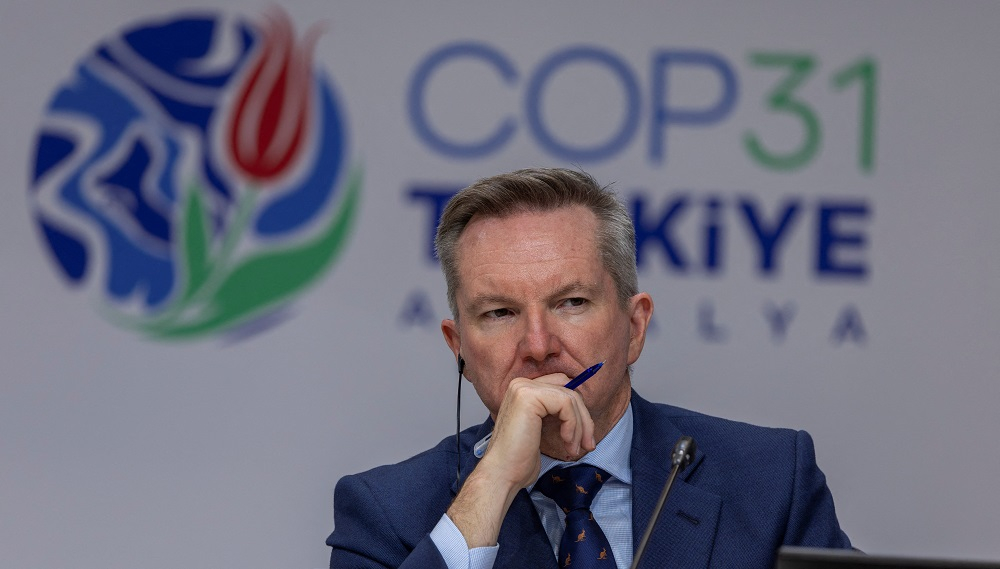
UN climate talks co-host Australia unveiled a new draft agreement on Thursday that drops any mention of fossil fuels, the leading driver of global warming, sparking anger from campaign groups.
The nearly 200 nations involved in the COP31 global climate talks in Türkiye have until Friday to strike a final agreement, though the marathon negotiations often run into overtime.
The summit is unfolding against a record-breaking El Nino, disasters fuelled by climate change from Europe to Nepal and a global energy shock triggered by the Iran war.
A sweeping draft pact unveiled earlier in the week laid out competing positions on flashpoint topics from energy to finance and trade, drawing criticism for its length and complexity.
After days of tense consultations, Australia published a slimmed-down text half the original length containing fresh language and new proposals on some of the thorniest issues.
"We'll be engaging in intense consultations with every single group starting this afternoon and into the night," Australia's Climate Minister Chris Bowen, who is steering the negotiations, told reporters.
Government ministers offered little immediate comment as they absorbed the fresh proposal.
Panama earlier threatened to block any deal that does not include a cap on global oil production, among other demands.
Bowen said he had not yet seen Panama's letter of objections.
An earlier proposal "for accelerated action to phase out fossil fuels" was nixed in the revised text, and all mentions of coal, oil and gas removed from the nine-page document.
The omission is striking given last year's summit also failed to mention fossil fuels, while countries have pursued efforts outside the United Nations process to exit coal, oil and gas.
"Some major fossil energy producers are attempting to undermine everything related to emissions cuts and the energy transition – and with this draft, they are succeeding," Inga Fritzen Buan from environmental group WWF said.
"This is not a mere disagreement over the placement of a comma."
Nations agreed at COP28 in Dubai in 2023 to transition away from fossil fuels, but language around energy sources is highly contested at the annual UN climate talks, where decisions are taken by consensus.
"Erasing explicit calls to transition away from fossil fuels... is a glaring regression. You cannot solve a fossil fuel crisis by pretending we don't need to phase out fossil fuels," said Harjeet Singh, convenor of the Fill the Fund campaign.
The draft "cover decision" is designed to capture the outcome of COP31 and set the course for future action as global temperatures rise and climate disasters multiply.
Mohamed Adow from campaign group Power Shift Africa said COP31 "has been muzzled on the most important threat causing the climate crisis... This new text has gone backwards."
The latest text said that taking steps to electrify the global economy could have "significant benefits" in shoring up energy security and cutting planet-heating greenhouse gas emissions.
It includes a call to increase the global share of final energy demand met by electricity to 35 percent by 2035 – a key initiative of COP31 host Türkiye.
Some countries are concerned the text as written does not explicitly require that extra electricity be powered by clean energy and not coal or gas.
"We are going to fight for clean electrification" met by renewables and nuclear energy, French Ecological Transition Minister Monique Barbut told reporters.
Some countries rejected calls to ramp up carbon capture, utilisation and storage technology, which critics see as an expensive distraction from cutting pollution.
Vanuatu's Climate Minister Ralph Regenvanu said it "had been singled out for special attention that it doesn't deserve" in the latest text.
The draft also proposes further discussions towards "tripling" finance for climate adaptation measures by 2035, but drops a US$120-billion goal being sought by developing nations.
The draft expresses "deep concern" about the imminent breach of the 1.5C temperature goal set under the 2015 Paris accord, and underscores the "importance" of the work of the Intergovernmental Panel on Climate Change (IPCC), the world's leading authority on global warming. (AFP)
Edited by Cecil Wong
Fossil fuels scrubbed from draft UN climate deal
2026-11-20 HKT 07:24
Share this story


