


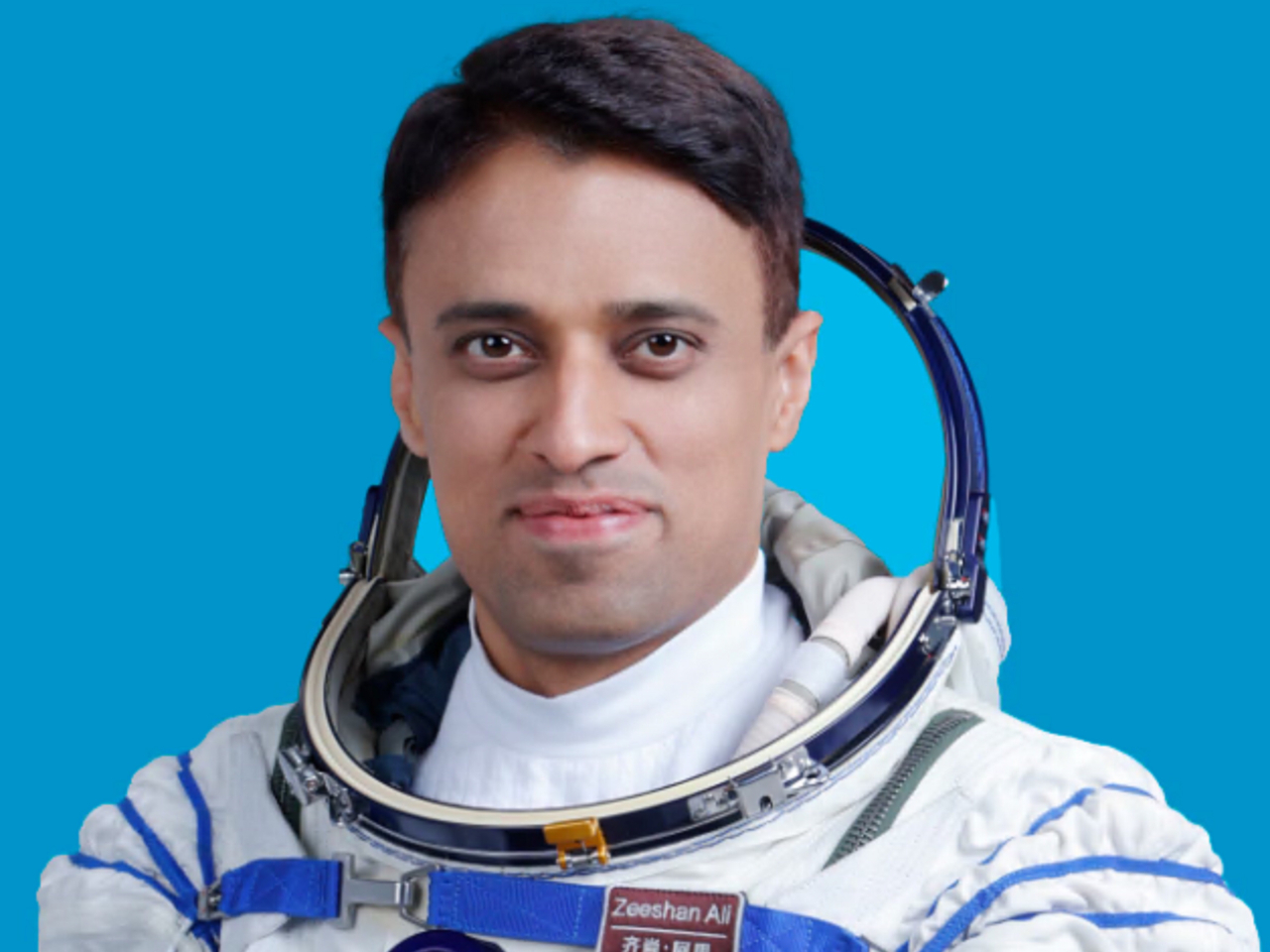
Pakistani astronaut Muhammad Zeeshan Ali completed his assigned experiment involving photosynthetic cyanobacteria aboard China's Tiangong space station on Saturday, his fourth day in the space station.
Ali arrived at the space station aboard the Shenzhou-24 spacecraft on Wednesday, together with Chinese astronauts Tang Hongbo and Wu Yi, becoming the first foreign astronaut to do so.
During the Shenzhou-24 mission, four scientific experiments under China-Pakistan international cooperation will be carried out in the space station for the first time.
The Pakistani side led the design of the experiment plans and the demonstration of scientific objectives, while the Chinese side provided engineering support to facilitate their implementation.
The experiment materials, including photosynthetic cyanobacteria, the grain crop quinoa, graphene hybrid composite materials and carbon fiber composite materials, had arrived at the space station in advance.
One of Ali's assigned tasks was to conduct the cyanobacteria experiment. Already adapted to life in space, Ali pulled himself along the handrails and glided effortlessly into the Wentian lab module.
Meanwhile, experts from China and Pakistan on the ground in Beijing were ready to provide support. Once the space-ground communication link was established, Ali began his work in coordination with the scientists.
Ali took out the container used for the photosynthetic cyanobacteria experiment, and used a camera to document the cyanobacteria's growth. The images were jointly interpreted by the space and ground teams. Then he gently shook the container according to the experiment procedures, before completing another round of photographing and transmission of images.
The choice of cyanobacteria as a research subject was particularly significant.
Cyanobacteria are the oldest oxygenic photosynthetic organisms on Earth and are considered promising candidate species for developing closed-loop ecosystems in space.
They can absorb carbon dioxide and release oxygen while also being rich in high-quality protein. These characteristics make them valuable subjects for research into stable and controllable extraterrestrial life-support systems, a key challenge for humanity as it ventures into deep space.
"At present, the first round of in-orbit sampling for the cyanobacteria experiment has been completed, and the remaining batches of cyanobacteria will be sampled and preserved later as planned," said Zhang Yuxin, an engineer at the Technology and Engineering Center for Space Utilization under the Chinese Academy of Sciences.
Ali will return to Earth with the Shenzhou-23 astronauts Zhang Zhiyuan and Hong Kong's Lai Ka-ying.
Shenzhou-23 astronaut Zhu Yangzhu, who has already spent six months in orbit for a year-long stay experiment, will remain aboard the space station for the Shenzhou-24 mission together with commander Tang Hongbo and astronaut Wu Yi.
When Ali returns to Earth, he will bring back the first batch of cyanobacteria samples for the research team to conduct further in-depth analysis and research. (Xinhua)
Edited by Edmond Fong
Pakistani astronaut completes space experiment
2026-11-29 HKT 17:32
Share this story


