


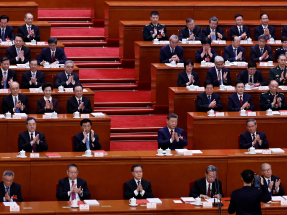
Artificial intelligence has rapidly evolved from a subject of public fascination to a fundamental pillar of the nation's industrial strategy, according to top government officials at the annual National People's Congress meeting in Beijing.
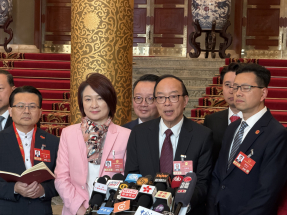
Speaking to reporters in the "Ministers' Corridor" following the opening ceremony on Thursday, Minister of Industry and Information Technology Li Lecheng highlighted the accelerating integration of AI into the industrial sector.
He said more than 30 percent of China's large-scale industrial enterprises had already adopted AI technologies by the end of the last year.
"You can see that unmanned production is such that human-machine collaboration is becoming a common scene in workshops and factories, and covers areas such as improving designs, manufacturing, efficiency improvement, quality inspection and other aspects," Li said.
He also pointed to the growing presence of smart terminals in everyday life, with AI-powered glasses, mobile phones and computers becoming increasingly popular consumer products in homes across the country.
Li also underscored China's growing dominance in advanced robotics, revealing that the nation took the wraps off more than 300 types of humanoid robots last year – accounting for more than half of the global total.
Minister of Science and Technology Yin Hejun said the country's technological progress would not only fuel high-quality economic growth and modernisation but also deliver tangible improvements to people's livelihoods.
Describing the 15th Five-Year Plan period as a "crucial window" for accelerating scientific progress, he detailed a four-pronged strategy focused on strengthening innovation and technological breakthroughs, industrial transformation, regional synergy and ecosystem development.
"We will carry out major sci-tech research targets and roll out systemic arrangements covering AI and quantum technology, among other emerging technologies," Yin said.
"Meanwhile, we will solve all the bottleneck issues standing in the way of innovation, so sci-tech innovation will drive the development of new quality productive forces."
A key component of the plan involves modernising the industrial system by revitalising traditional industries and injecting them with new vitality through technological innovation.
Yin also highlighted the importance of strengthening integrated innovation and improving regional systems to foster collaboration.
"The Beijing-Tianjin-Hebei area and the Shanghai-Yangtze River Delta and the Pearl River Delta... will become highlands of sci-tech innovation, [places for] the cultivation of talents, and they will also become the key pillars of China's strategic sci-tech capacity," he said.
Yin also called for the development of world-class innovation ecosystems through strengthened capacity in basic research.
Edited by Thomas McAlinden
AI 'is now at the core of China's industrial strategy'
2026-03-05 HKT 14:13
Share this story


2026-03-12 HKT 16:42
2026-03-12 HKT 16:37

2026-03-11 HKT 14:22

2026-03-11 HKT 11:58

2026-03-11 HKT 11:51
2026-03-10 HKT 12:56
2026-03-10 HKT 08:42
2026-03-09 HKT 20:28
2026-03-09 HKT 18:32
2026-03-09 HKT 17:11
2026-03-09 HKT 13:29
2026-03-09 HKT 12:28
2026-03-08 HKT 16:21
2026-03-08 HKT 11:44
2026-03-07 HKT 18:22
2026-03-07 HKT 15:05
