


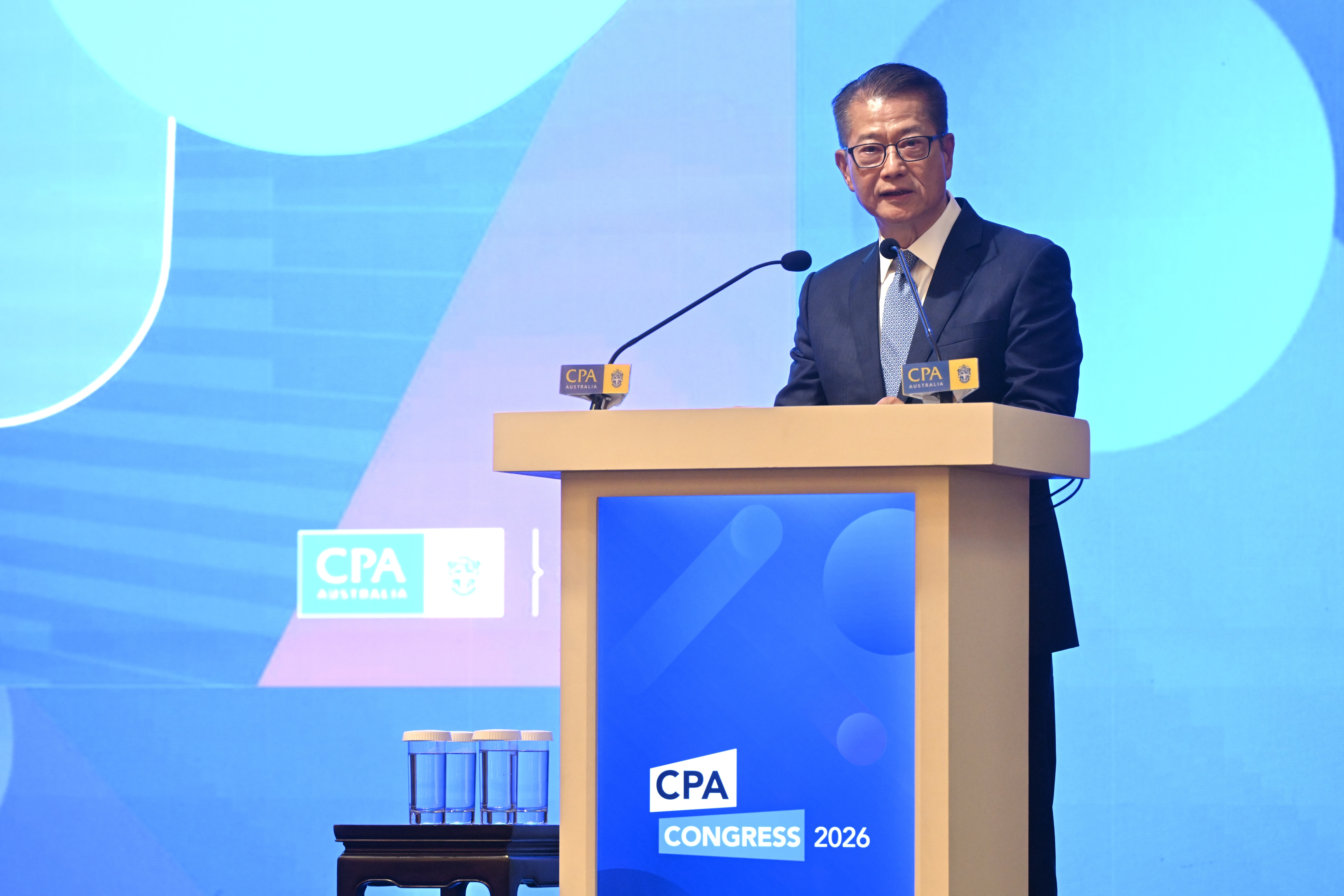
Financial Secretary Paul Chan said on Thursday Hong Kong's first five-year plan provides a clear framework for policymaking and investment, urging businesses to understand the government's strategies and priorities so they can "plan and invest with confidence".
Speaking at a business forum, Chan highlighted two connected priorities – finance, and innovation and technology – in the plan, which was unveiled last month.
"For Hong Kong, we are equally determined to turn opportunities into lasting outcomes," he said.
The government's "Finance+" approach, Chan pointed out, aims to develop new growth engines, support new industries and finance Hong Kong's green transition.
"Hong Kong brings together capital, innovators, enterprises and professional expertise.
"We want to put these strengths to fuller use, thereby developing new growth engines, supporting new industries, helping businesses transform and expand, as well as financing the green transition.
"The question is not simply how much capital we attract but what that capital makes possible."
Chan noted that Hong Kong's close connection with the mainland is central to this role, helping take technologies from the laboratory to the market at scale while marrying mainland strengths with international capital and global markets.
He cited strong IPO momentum in this regard, saying Hong Kong raised some HK$388 billion in the first nine months of this year, which was more than double that of a year earlier.
International investors from the United States, Europe, Southeast Asia and the Middle East are major players, while enterprises from the last two regions as well as Central Asia are exploring listing or bond-issuance opportunities.
On innovation and technology, Chan said the Northern Metropolis project is more than just about land and buildings.
"We are bringing education, research, talent, enterprises and industry together to create a new engine of growth," he said.
He highlighted the Hetao co-operation zone as a clear example, where Hong Kong and mainland authorities are strengthening cooperation in clinical research and drug regulation, attracting international pharmaceutical companies to conduct research and set up manufacturing facilities.
Edited by Aaron Tam
Five-year plan 'all about finding new growth engines'
2026-10-29 HKT 13:57
Share this story


