


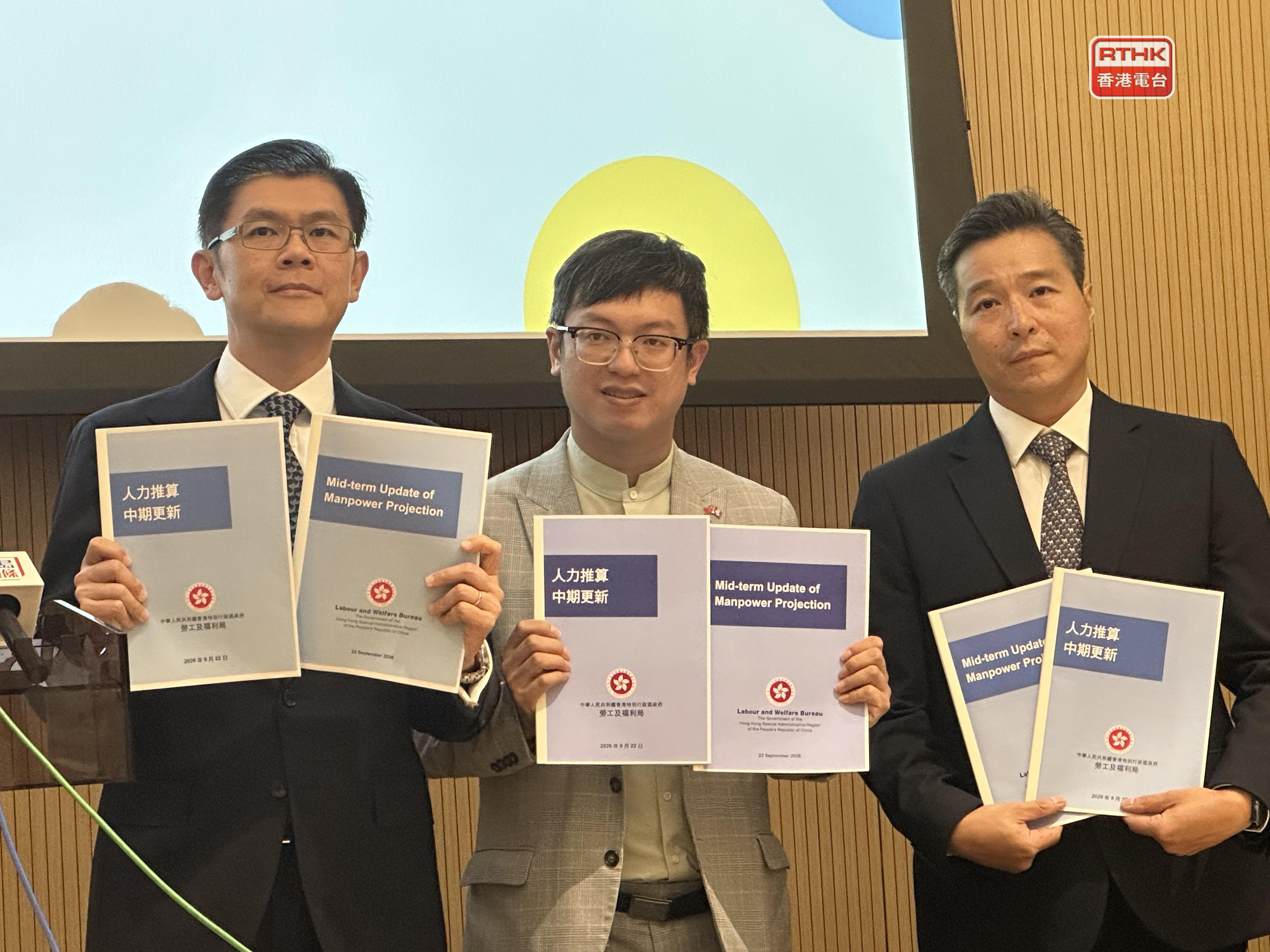
The government will help workers at all levels equip themselves for the new AI era as the emergence of frontier technology coincided with a plunge in clerical and entry-level positions for fresh university graduates, said Acting Secretary for Labour and Welfare Ho Kai-ming.
He spoke as Hong Kong's manpower situation remained tight across most key industries, with the government saying shortages had eased thanks to talent admission and labour importation measures taken over recent years.
The Mid-term Update of Manpower Projection released on Tuesday estimates a shortfall of 130,000 workers by 2028, down from an earlier forecast of 180,000.
Ho says demand in certain industries remains acute.
"Manpower remains tight across most key industries – especially innovation and technology, aviation, construction, city operations and healthcare," he said.
"Without the various labour importation measures, the overall shortfall would have widened to 300,000 due to an ageing population."
The report predicts that by 2028, construction will face the biggest crunch, with a shortfall of 30,000 to 40,000 workers.
It will be followed by a shortage of 20,000 to 25,000 for "city operations" and 13,000 to 18,000 for healthcare.
By occupation, the report says 60 percent of the shortfall is concentrated in "skilled technical workers" and "services and sales workers".
It explains that these roles rely on interpersonal interactions and complex craftsmanship, making them harder for AI to replace.
By contrast, as companies expand AI use for routine administrative tasks, "clerical support workers" are projected to have a surplus of about 25,000 to 30,000 by 2028.
Further analysing the impact of AI, researchers say entry-level jobs have been hit hard, with vacancies suitable for fresh graduates dropping sharply by about 60 percent compared to 2022.
Meanwhile, around 70,000 middle-aged clerical workers without post-secondary qualifications are now facing "transition pressure".
At the same time, demand for AI experts keeps growing, especially for "composite talent" who have both AI skills and sector-specific knowledge.
Ho stressed that the government would help workers at all levels gear up for the new AI era and ensure their skills align with Hong Kong's future economy.
More than 70 percent of workers were also found to have used AI on the job.
The Labour and Welfare Bureau projected the technology would boost productivity by 20 to 30 percent, but jobs in import and export and finance trades could be easily replaced by AI by the same percentage, research unit head Roy Chan said.
However, services and sales staff as well as skilled technical workers will not be so easily made redundant by AI adoption, he said.
But this also means these sectors will struggle to fill positions due to the prevalence of post-secondary education among jobseekers between 2005 and 2025.
Looking ahead, Chan believes demand for composite talents will rise drastically.
The SAR only has about 4,000 composite talents so far, he added.
_____________________________
Last updated: 2026-09-22 HKT 18:10
Edited by Raymond Yeung
Labour shortage eases, but entry-level jobs hit by AI
2026-09-22 HKT 17:49
Share this story


