



A senior fire services official has defended the decision not to activate Hong Kong's city-wide emergency alert system during November’s Wang Fuk Court blaze, citing fears of unpredictable responses from the Tai Po residential estate's inhabitants at the time.
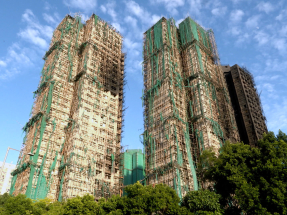
Deputy fire services director Derek Chan told the inquiry probing the inferno on Thursday that there were no other ways available to alert residents inside the estate's flats, whose windows had been covered as a result of the major-renovation work being carried out then, when the buildings' internal fire-alarm system had not been switched on.
Chan explained that he ultimately decided against using the emergency alert system – which allows government departments to warn mobile service users about dangers – as it would have taken an hour to send out the message and there was a lack of public education about the system itself.
“We couldn’t predict the responses of residents,” he said, adding that it could have been more dangerous for them to leave their homes at the time.
Chan also testified that the department had deployed more manpower than required for a level-five alarm at a time when the blaze was classified as a No. 4 alarm.
The independent committee heard that Chan had decided to upgrade the status of the fire to a level-five alarm, which involved a switch in command strategies for the main part.
Committee lead counsel Victor Dawes pointed to comments questioning why officials did not further upgrade the fire, which ultimately reached a level-five alarm, to the highest “disaster” level.
Chan said reaching such a level would have meant the available resources of all departments had been mobilised and "may involve support from the People’s Liberation Army".
The disaster alarm is reserved for citywide incidents or multiple simultaneous emergencies, he added.
The inquiry also heard that the breathing apparatus used by the firefighter, who perished in the inferno, Ho Wai-ho, was found to be damaged.
Divisional officer Tung Wing-kei testified that it was "very rare" for the gas cylinder valve and its connected handwheel to be damaged.
While such damage could have been the result of a strong impact, the department was unable to ascertain the exact cause as the device storing usage data had suffered water damage.
Wrapping up the day’s hearing, committee chairman David Lok commended the efforts of firefighters in tackling the Tai Po estate’s blaze.
"In the hearings, the Fire Services Department has been criticised. We urge that firefighting efforts be viewed separately from other fire-prevention issues," Lok said.
He added officers had to make "difficult decisions" during the blaze, particularly highlighting Chan’s decision to assign two senior officers to oversee operations for each building as "the right call".
Edited by Tony Sabine
'No Wang Fuk mobile alert sent over response fears'
2026-04-23 HKT 16:20
Share this story


2026-10-22 HKT 11:54
2026-10-16 HKT 16:35

2026-10-11 HKT 17:58
2026-10-06 HKT 12:52
2026-09-15 HKT 13:56
2026-09-09 HKT 22:14
2026-09-03 HKT 17:12
2026-09-01 HKT 11:34
2026-08-31 HKT 21:05
2026-08-29 HKT 15:10
2026-08-28 HKT 15:23
2026-08-25 HKT 16:43
2026-08-23 HKT 11:38
2026-08-18 HKT 13:29
2026-08-12 HKT 15:20
2026-08-01 HKT 11:12
