


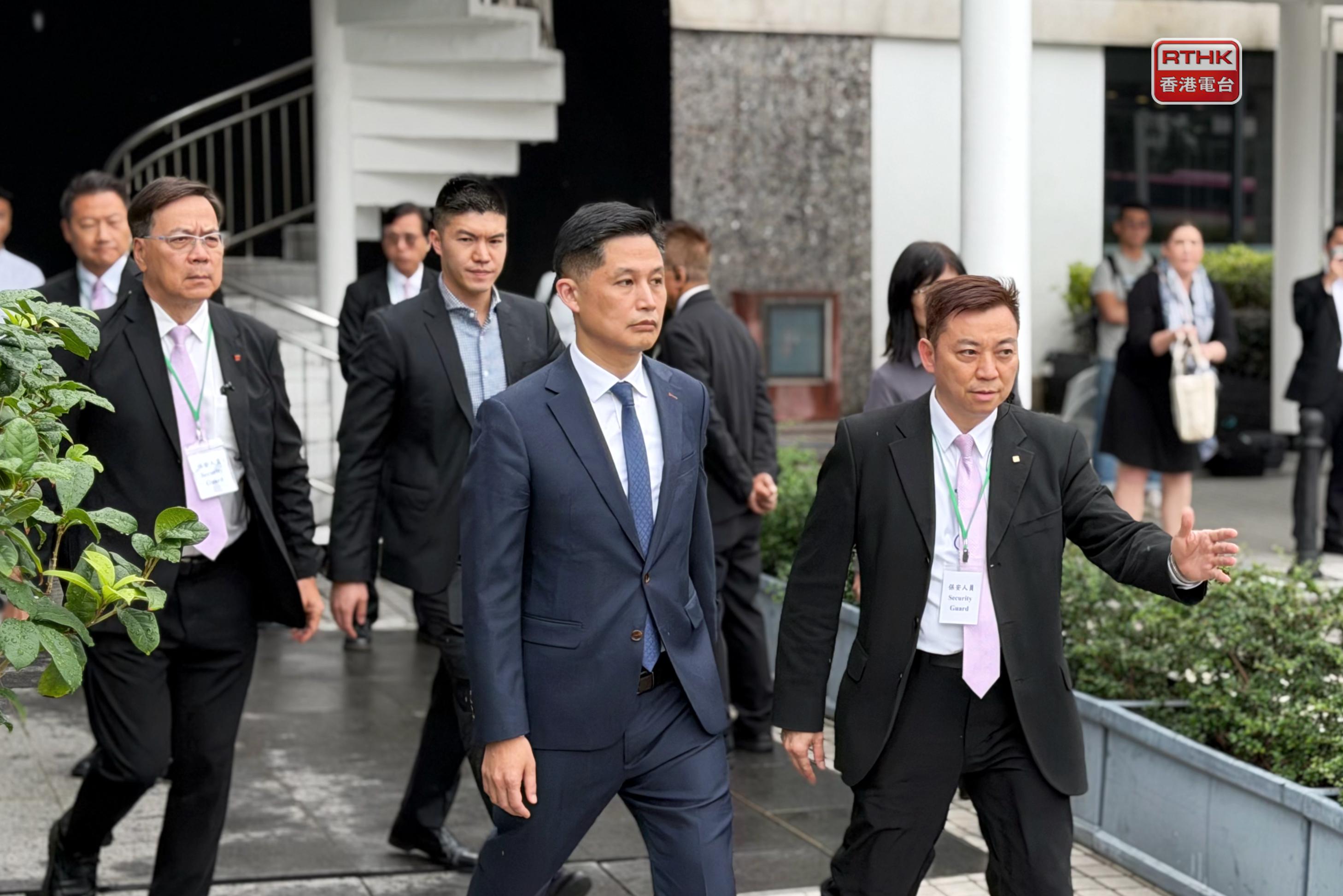
Fire service officials and building authorities both have statutory powers to oversee the use of polystyrene panels and temporary moveable boards installed at emergency staircases during renovation works, an independent committee probing the Wang Fuk Court blaze has heard.
Friday’s hearing delved into the duties of different government bodies such as the Fire Services Department (FSD), with its chief Andy Yeung testifying that authorities should work together better when it comes to fire safety.
Committee lead counsel Victor Dawes cited a judicial review in which the applicant — a mini-storage operator — claimed the FSD had overstepped its authority in issuing a fire hazards abatement notice, when it should have been followed up by the Buildings Department instead.
The ruling had accepted that the fire department was duty-bound to give advice on fire protection measures and fire hazards, and Dawes questioned whether it contradicted previous testimonies by fellow officers that the use of materials such as foam boards at the Tai Po estate was outside the department’s jurisdiction.
Yeung, the highest-ranking official to testify to date, said more efforts were required back then for cooperation between fire and building authorities, but now the two bodies have an established division of labour mechanism over construction issues.
The fire service chief said both departments have statutory powers to oversee the use of foam boards and temporary openings on emergency staircases, while emphasising that collaboration between the two was essential before taking action.
“The overall fire safety does not only concern one department or two departments. It involves collaboration between departments to complement each other,” Yeung said.
He noted that his department is seeking to amend existing legislation, with a bill expected to be submitted to the legislature for consultation next month.
The department has tightened its scrutiny of shutdown notices, Yeung said, asking contractors to explain any deactivation of fire services installations to determine if it’s necessary.
The fire service director also revealed that his department had added 30 more phone lines to answer emergency calls, with another 30 expected in around two months.
Yeung said a fourth generation mobilising system, which was originally scheduled for launch in 2022, has entered the testing stage.
He said the new system would look into the issue of handling repeated emergency calls “with caution”, as some might be made by different people regarding the same address.
Edited by Tony Sabine
Close communication key among govt depts, probe hears
2026-04-24 HKT 16:04
Share this story


2026-10-22 HKT 11:54
2026-10-16 HKT 16:35
2026-10-11 HKT 17:58
2026-10-06 HKT 12:52
2026-09-15 HKT 13:56
2026-09-09 HKT 22:14
2026-09-03 HKT 17:12
2026-09-01 HKT 11:34

2026-08-31 HKT 21:05
2026-08-29 HKT 15:10
2026-08-28 HKT 15:23
2026-08-25 HKT 16:43
2026-08-23 HKT 11:38
2026-08-18 HKT 13:29
2026-08-12 HKT 15:20
2026-08-01 HKT 11:12
